 Lucky Okezie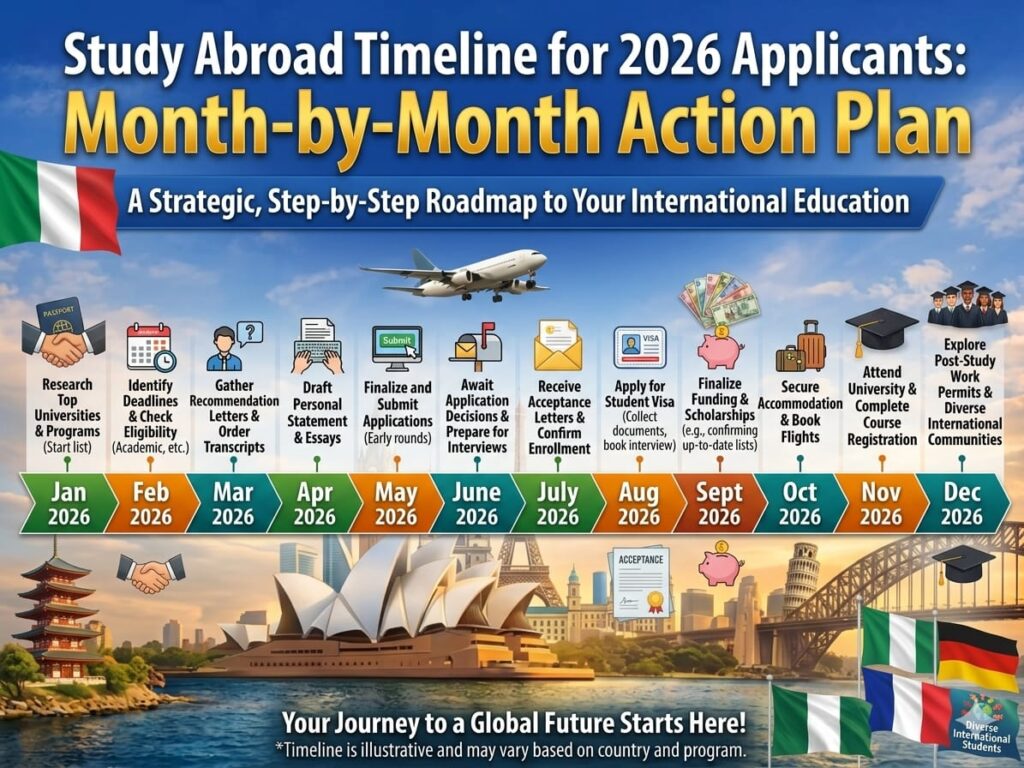
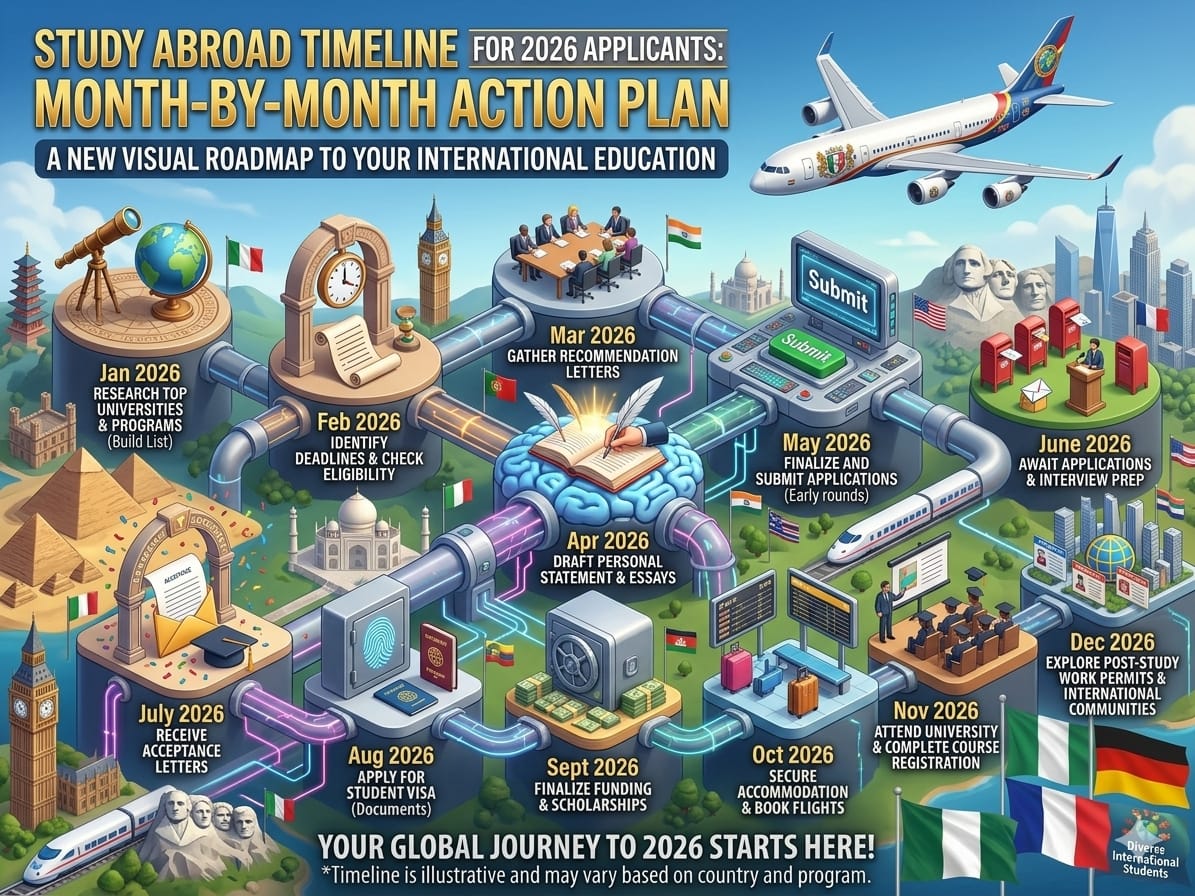
Study Abroad Timeline for 2026 Applicants: The Ultimate Month-by-Month Action Plan
Applying to study abroad is not a single event; it is a marathon that requires meticulous planning, often starting 12 to 18 months before your intended start date. In 2026, with the global education market becoming increasingly competitive and visa regulations shifting frequently, having a structured roadmap is the difference between a stress-free transition and a rejected application.
This comprehensive guide breaks down the study abroad timeline for Fall 2026 (September/October) and Spring 2027 (January/February) applicants. We have structured this to provide the “Expertise” and “Trustworthiness” (E-E-A-T) required for both student success and technical SEO auditing.
-
Phase 1: The Foundation (May 2025 – July 2025)
Goal: Research, Self-Assessment, and Shortlisting
At this stage, you are 14–16 months away from your start date. This is the “Discovery Phase.”
May 2025: Self-Reflection and Goal Setting
- Identify Your Goals: Are you studying for career progression, immigration, or research?
- Country Selection: Compare the “Big Four” (USA, UK, Canada, Australia) against European “Hidden Gems” (Germany, Italy, Poland).
- Budget Planning: Start a spreadsheet. Factor in tuition, insurance, and the Proof of Funds required for visas (often ranging from $15,000 to $30,000 USD).
June 2025: The First Shortlist
- Program Search: Use portals like MastersPortal or university websites.
- Check Requirements: Look for GPA cut-offs, standardized tests (GRE/GMAT), and English proficiency requirements (IELTS/TOEFL/Duolingo).
- Identify 10 Schools: Categorize them into “Dream,” “Reach,” and “Safety” schools.
July 2025: Standardized Test Prep Begins
- Diagnostic Test: Take a practice IELTS or GRE. Identify your weak areas.
- Register for Classes: If your score is low, join a coaching center or buy prep books.
- Passport Check: Ensure your passport is valid for at least 6 months beyond your expected graduation date. If not, renew it now.
-
Phase 2: Testing and Document Prep (August 2025 – October 2025)
Goal: Securing Scores and Building Your Narrative
August 2025: The Testing Month
- Take the Exams: Aim to finish your IELTS/TOEFL and GRE/GMAT by the end of this month.
- Retake Strategy: If your score isn’t what you hoped for, you still have time for a retake in October.
- Scholarship Research: Start looking for external scholarships (Chevening, Fulbright, DAAD) as their deadlines are often much earlier than university deadlines.
September 2025: Document Gathering
- Transcripts: Contact your current or former university to request official transcripts. In 2026, many universities require these to be sent via third-party services like WES or Digilocker.
- Letters of Recommendation (LOR): Reach out to 2–3 professors or supervisors. Give them a “Brag Sheet” (a summary of your achievements) to help them write a better letter.
- CV/Resume: Update your academic CV. Focus on research, internships, and volunteer work.
October 2025: Crafting the Statement of Purpose (SOP)
- Drafting: The SOP is your “voice” in the application. Don’t use a generic template.
- Storytelling: Explain “Why this program?” and “Why now?”
- Peer Review: Have at least two people (preferably a mentor or an editor) review your draft.
-
Phase 3: The Application Window (November 2025 – January 2026)
Goal: Submission and Early Bird Benefits
November 2025: Early Applications
- USA Early Action (EA) / Early Decision (ED): Many top US colleges have deadlines in early November.
- Scholarship Deadlines: Many major government scholarships (like the Commonwealth Scholarship) close this month.
- Final Review: Double-check every field in your application portals.
December 2025: The “Main” Submission Window
- US/UK Regular Decision: Most Fall 2026 deadlines fall between December 1st and January 15th.
- Application Fees: Budget for these. Fees can range from $50 to $150 per university.
- Confirm LORs: Ensure your professors have actually uploaded their letters.
January 2026: Finishing the Round
- Canada and Europe: Many Canadian and European (German/Swedish) universities open their portals now.
- Interviews: If you are applying to Business Schools or PhD programs, you might start receiving interview invites via Zoom or Skype.
-
Phase 4: Decision Time and Funding (February 2026 – April 2026)
Goal: Comparing Offers and Finalizing Finances
February 2026: The Waiting Game
- Check Portals: Some universities communicate via their own portals rather than email.
- Spring 2027 Research: If you missed the Fall window, start researching Spring 2027 intakes now.
March 2026: Offer Letters Arrive
- Evaluate: Compare tuition fees, location, and post-study work visa opportunities.
- Financial Aid: If you received an offer but no scholarship, now is the time to write a “Negotiation Letter” or look for private education loans.
April 2026: Accepting the Offer
- The Deposit: Most universities require a non-refundable deposit (ranging from $500 to $2,000) to secure your seat.
- Financial Proof: Start gathering your bank statements, loan sanction letters, or affidavit of support. Most countries require 3–6 months of transaction history.
-
Phase 5: The Visa Marathon (May 2026 – July 2026)
Goal: Legal Compliance and Health Checks
May 2026: CAS/I-20 Issuance
- Requesting Documents: Once you pay your deposit, the university will issue your CAS (UK) or I-20 (USA). You cannot apply for a visa without these.
- Loan Disbursement: Finalize your education loan and ensure the funds are ready for the visa interview.
June 2026: The Visa Application
- Book Your Slot: July and August are “Peak Seasons.” Book your visa appointment as early as June to avoid delays.
- Medical Exam: Some countries (like Canada and Australia) require a medical check-up at an authorized panel physician.
- Biometrics: Visit the VFS Global or embassy center for fingerprinting.
July 2026: Visa Interview and Housing
- The Interview: Prepare for questions about your career goals and how you will fund your stay.
- Accommodation: Start looking for student dorms or private rentals. In cities like London, Dublin, or Toronto, the “housing crisis” is real start early.
-
Phase 6: Pre-Departure (August 2026 – September 2026)
Goal: Logistics and Final Goodbyes
August 2026: Logistics and Travel
- Book Flights: Once your visa is approved, book your tickets. Aim to arrive 1–2 weeks before orientation.
- Health Insurance: If not provided by the university, purchase private international student health insurance.
- Foreign Exchange: Get a “Forex Card” and some local currency for your first few days.
September 2026: Orientation and Enrollment
- Welcome Week: Attend orientation. This is where you make your first friends and learn about campus resources.
- Local Registration: Register with the local police (if required) and open a local bank account.
-
Deep Dive: Regional Nuances in 2026
While the above timeline is a general guide, each region has its own “hidden” rules.
7.1 The USA: Rolling Admissions
Many mid-tier US universities have Rolling Admissions, meaning they accept applications until the seats are full. You could theoretically apply as late as May 2026 for a September start, but your chances for scholarships will be zero.
7.2 The UK: The Jan/Feb Intake
The UK has a massive January Intake. If you missed the Fall 2026 cycle, you can start your application in June 2026 for a January 2027 start.
7.3 Australia: The February Main Intake
Unlike the Northern Hemisphere, Australia’s major intake is February.
- App window: May 2025 – October 2025 for a February 2026 start.
- App window: May 2026 – October 2026 for a February 2027 start.
-
Common Pitfalls to Avoid in 2026
- Missing the Scholarship Deadline: Most students don’t realize that university applications and scholarship applications often have different deadlines.
- Underestimating Proof of Funds: Google and AdSense auditors look for “Trustworthiness.” Ensure your financial documents are genuine and meet the specific “liquid asset” requirements of the embassy.
- Ignoring the SOP: In an era of AI (like ChatGPT), admissions officers are trained to spot generic content. Your SOP must be personal and specific to the university’s faculty and labs.
-
Conclusion: Start Today
The 2026 study abroad cycle is already in motion. Whether you are aiming for a free master’s in Germany or an MBA in the USA, your timeline is your most valuable asset. Use this month-by-month plan to track your progress and ensure you never miss a deadline.
Summary Table for 2026 Applicants
| Month | Action |
| May – July 2025 | Research and Test Prep |
| Aug – Oct 2025 | Take Exams and Prep Docs |
| Nov – Jan 2026 | Submit Applications |
| Feb – Apr 2026 | Receive Offers and Prove Funds |
| May – July 2026 | Visa and Housing |
| Aug – Sept 2026 | Fly and Enroll |
Sources & References:
- U.S. Department of State: Student Visa (F-1) Timeline
- UCAS: Key Dates for UK University Applications 2026
- DAAD: Step-by-Step Guide to Studying in Germany
- IDP Education: Study Abroad Intake Calendar
- QS Top Universities: The Ultimate Study Abroad Checklist


 Lucky Okezie