 Lucky Okezie
How to Apply to Multiple Universities Abroad Without Paying Extra Fees
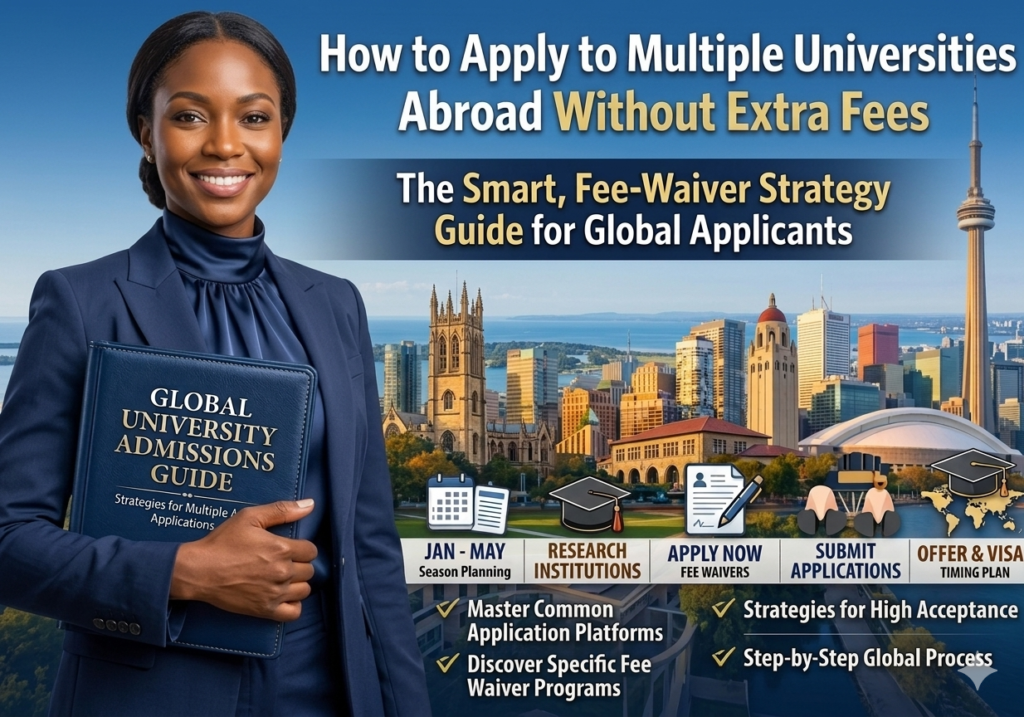
A comprehensive framework for maximizing multi-institutional international applications while completely eliminating financial barriers.
Table of Contents
1. Executive Summary & Strategic Landscape
Applying for international higher education has historically carried heavy transactional friction. For global applicants targeting multiple destinations, application fees present a substantial, cumulative financial hurdle. With single institutional application charges ranging from $50 to over $150 USD across premium destinations like the United States, Canada, and Australia, a diversified application pool of 8 to 12 institutions can easily command an upfront investment exceeding $1,000 USD. This fiscal barrier exists even before accounting for localized visa assessments, testing reports, or credential translations.
However, the contemporary international admissions landscape in 2026 offers sophisticated, regulatory, and institutional workarounds designed to lower entry barriers, promote socio-economic diversity, and optimize enrollment analytics. By deploying a systematic methodology that synchronizes institutional behaviors, centralized state systems, economic hardship categories, and regional funding models, international candidates can scale their applications globally without allocating capital toward application fees. This manual provides an exhaustive blueprint for implementing a multi-university, zero-fee application framework across the world’s leading educational hubs.
2. Maximizing Centralized Application Portals
Centralized platforms manage millions of student entries concurrently. Rather than engaging directly with individual institutional web portals which frequently mandates siloed processing fees—strategic candidates optimize aggregate entry routes that offer fixed-price caps, built-in waiver mechanism requests, or systemic cost eliminations.
The Common Application & Coalition Application (United States)
In the United States, the Common Application and the Coalition Application dominate undergraduate admissions. Both configurations possess integrated structural paths designed to bypass institutional processing fees entirely based on programmatic qualifications or socioeconomic status. Within the Profile parameters of the Common Application, candidates can prompt an institutional fee waiver request by indicating affirmative markers for domestic or international financial hardship indicators. These markers include eligibility for federal free or reduced-price lunch systems, participation in state-subsidized support programs, or formal contextual declarations verified by a designated high school guidance counselor.
Crucially for international students, selecting the “Economic Hardship” option triggers an automated electronic request to the applicant’s school counselor. Once the counselor uploads a brief digital confirmation affirming that the fee places an undue burden on the family’s financial infrastructure, the waiver is systematically applied across all added institutions on the applicant’s platform list. This singular verification loop can yield thousands of dollars in fee savings across up to 20 universities simultaneously.
UCAS System Optimization (United Kingdom)
The Universities and Colleges Admissions Service (UCAS) manages undergraduate application pipelines across England, Scotland, Wales, and Northern Ireland. While the United Kingdom does not feature generalized individual hardship waivers for international candidates within its central system, its foundational structure is highly cost-optimized compared to individual processing models. Under the unified UCAS fee architecture, an international applicant pays a singular, non-divisible flat fee of approximately £28.50 to apply to up to five distinct university programs simultaneously.
By using this layout, the marginal cost of adding a second, third, fourth, or fifth choice cascades down to absolute zero. This approach completely supersedes the distinct $100 per-campus assessment frameworks common in other jurisdictions. For postgraduate tracks, where applications bypass UCAS and flow straight to the university portals, candidates can utilize direct academic track waivers by demonstrating institutional partnership pathways or sponsoring agreements.
3. Unlocking Institutional Application Fee Waivers
Independent of centralized portals, individual universities across the globe maintain specific, behavior-driven waiver systems. These systems are strategically designed to reward engagement, bolster enrollment yields, and identify high-caliber candidates who show genuine interest.
Virtual Engagement and Informational Webinars
The global shift towards digital recruitment has created an actionable opportunity for cost-conscious applicants. Major academic institutions across North America and Europe host regular virtual information sessions, departmental open houses, and international student webinars. To maximize and audit attendance, admissions offices correlate registration databases with their application software backend.
Attending these live, authenticated web broadcasts frequently results in an automated email containing a unique application fee waiver code. In many instances, the institution explicitly states during the webinar that all international participants will receive a $0 application code to use in their active portal. For competitive tracks, institutions use these events to filter out passive applicants, ensuring that their fee-free opportunities are directed toward highly engaged students.
Direct Institutional Outreach and Cold Communication
For postgraduate, research-driven, or highly specialized programs, candidates can bypass generic fee rules through structured cold outreach. This involves directly messaging the university’s graduate admissions office, a department chair, or a prospective faculty supervisor. This methodology relies on providing compelling academic evidence before initiating the formal application submission process.
When drafting these communication variants, applicants should supply their complete academic curriculum vitae, unofficial grade transcripts, and a concise summary of their research interests. If an applicant shows exceptional promise, an academic department can issue an administrative waiver code. This is done to prevent the applicant from choosing a competing institution simply because of upfront transactional costs.
Alumni and Professional Network Endorsements
Many private and liberal arts institutions offer application fee waivers to candidates who have their applications formally endorsed by a current alumnus of the school. These programs, often referred to as “Alumni Fee Waivers” or “Legacy Engagement Trackers,” allow former graduates to provide a unique code or sign a validation form on behalf of a prospective student. Candidates can secure these endorsements by building professional relationships on networks like LinkedIn with alumni working in their prospective fields.
4. Targeting No-Fee Universities and Geographies
The most absolute method to apply to multiple international higher education institutions without incurring fees is to target countries whose national frameworks completely outlaw or systematically discourage institutional application charges.
Germany’s Public Higher Education Infrastructure
Germany represents a major global center for completely fee-free university applications. The public university framework across almost all German states provides world-class education with minimal tuition fees. This non-commercial approach also applies to the initial application process. Many public universities allow international candidates to apply directly through their internal web portals without charging any assessment or processing fees.
When dealing with German universities that require processing through the centralized uni-assist portal, there is a standard processing fee. However, applicants can maintain a zero-fee footprint by focusing on institutions that handle applications directly or by securing DAAD (German Academic Exchange Service) scholarships. These scholarships provide comprehensive fee waivers as part of their award packages.
The Nordic Framework (Norway, Finland, and Sweden)
The Nordic educational ecosystem operates on a public-good model. In Norway, public universities do not charge tuition fees or application fees to international applicants, regardless of their country of origin. While regional systems in Sweden and Finland have introduced application fees for non-EU/EEA nationals, exceptions exist for students applying under specific exchange partnerships, institutional bilateral agreements, or state-funded scholarship initiatives. This allows strategic applicants to navigate the entire system with zero out-of-pocket costs.
Select Elite Private Colleges in the United States
In contrast to large public university networks that rely on application fees to fund their processing operations, a selective group of elite private liberal arts colleges in the United States maintains a permanent $0 application fee policy for all international applicants who submit online. Institutions such as Colby College, Carleton College, Kenyon College, and Denison University do not charge application fees. This policy ensures that financial limitations do not deter high-achieving global applicants from entering their consideration pools.
6. Multi-University Fee-Waiver Preparation Timeline
Successfully executing a zero-fee application strategy across multiple international universities requires careful planning and precise timing. The matrix below outlines the exact steps and timelines required to align your application milestones with cost-saving verification standards.
| Step | Strategic Action Item | Target Timeline | Cost-Saving & Verification Standard |
|---|---|---|---|
| 1 | Geographic & Institutional Mapping | 8 Months Prior to Deadline | Build a balanced university list that includes German public institutions, fee-free U.S. liberal arts colleges, and universities that accept unofficial transcripts. |
| 2 | Virtual Campaign Recruitment Engagement | 6 Months Prior to Deadline | Register for and attend online open houses and international student webinars to collect unique, institutional fee waiver codes. |
| 3 | Counselor Hardship Verification Setup | 4 Months Prior to Deadline | Meet with your high school counselor or university registrar to set up standard financial hardship documentation or fee waiver confirmation letters. |
| 4 | Central Portal Waiver Execution | 3 Months Prior to Deadline | Select the financial waiver request options within centralized portals (such as the Common App) to trigger automated counselor verification loops. |
| 5 | Test Day Score Allocation & Self-Reporting | 2 Months Prior to Deadline | Use the free score recipient slots on your test registration day, or select universities that accept self-reported scores in their initial portal review. |


 Lucky Okezie