Lucky Okezie
SOP vs Personal Statement: Key Differences Most Applicants Miss
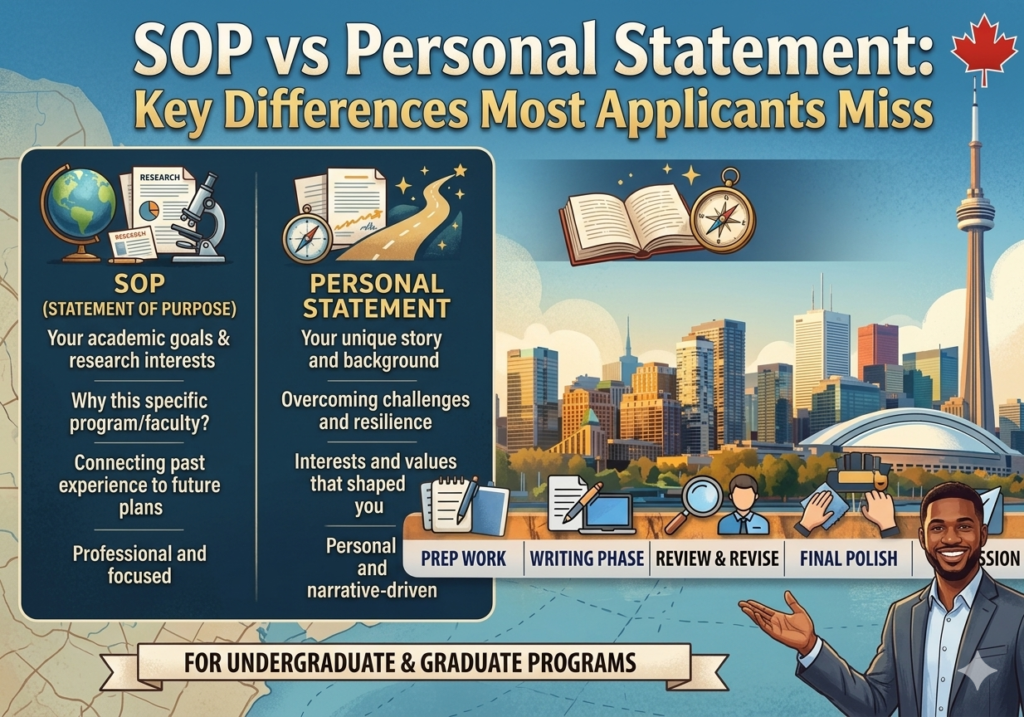
Table of Contents
1. The Core Conceptual Divide
One of the most pervasive and damaging mistakes international applicants make when submitting credentials to institutions in the United States, United Kingdom, and Canada is treating the Statement of Purpose (SOP) and the Personal Statement as interchangeable documents. When an admissions committee requests both essays within a single application portal, submitting overlapping or copied text serves as an immediate red flag, indicating a lack of strategic insight and analytical precision.
The distinction between these two components lies within their foundational lenses. The Statement of Purpose is a forward-looking, professional, and objective document designed to prove your academic readiness, research competency, and precise alignment with a specific department. Conversely, the Personal Statement is a contextual, narrative, and reflective essay that highlights your human journey, character development, and resilience. Understanding this subtle divide is essential for maximizing your admission odds.
2. Deconstructing the Statement of Purpose (SOP)
The Statement of Purpose acts as a professional roadmap or research proposal tailored for an audience of expert scholars. It focuses on intellectual curiosity, technical capability, and long-term career goals rather than your personal history.
Core Operational Pillars
- The Academic Trajectory: This section provides a detailed analysis of your foundational training. It highlights specialized coursework, specific methodologies mastered, and relevant academic milestones rather than simply repeating your transcripts.
- Research Accomplishments & Methodologies: You must explicitly detail any past laboratory work, undergraduate theses, field data collections, or publications. It is critical to describe the technical toolsets used, such as specific programming languages or statistical packages, to establish your technical competence.
- Granular Institutional Fit: This is the defining element of a high-tier SOP. You must state exactly why the target university is the optimal ecosystem for your goals. This requires citing active research labs, specific peer-reviewed publications by faculty members, and unique institutional resources.
Tone and Narrative Delivery
The tone of an SOP must remain strictly analytical, formal, and objective. It avoids overly dramatic prose or sentimental hooks, opting instead to structure arguments around clear hypotheses, academic milestones, and defined professional objectives.
3. Deconstructing the Personal Statement
While the SOP establishes whether you possess the intellectual capability to execute a rigorous program, the Personal Statement answers a entirely different question: Who are you as a human being, and how will you enrich our institutional community? This essay explores the qualitative context behind your quantitative achievements.
Core Operational Pillars
- Socio-Economic & Personal Context: This section outlines the unique environmental factors, systemic barriers, or background experiences that shaped your worldview. This is the ideal area to discuss coming from an underrepresented community, being a first-generation student, or navigating cultural transitions.
- Resilience and Problem-Solving Layouts: Rather than framing challenges as simple complaints, a strong Personal Statement showcases active resilience. It uses personal setbacks such as financial constraints or family responsibilities as evidence of your adaptability, determination, and grit.
- Community Engagement and Interpersonal Value: This element focuses on your contributions outside the classroom. It details leadership roles, civic engagement, volunteer work, and cross-cultural collaborations that demonstrate your ability to positively impact campus culture.
Tone and Narrative Delivery
The Personal Statement relies heavily on narrative storytelling, vulnerability, and reflection. It leverages descriptive writing techniques to engage the reader, allowing the admissions committee to understand the core motivations that drive your academic pursuits.
4. The Overlap Trap: Critical Fault Lines to Avoid
When dual essays are required, applicants frequently fall into tactical traps that dilute the overall impact of their profile. Review these common errors to ensure your documents remain distinct and complementary:
- The Transcript Recitation Error: Do not use either essay to walk through your resume line-by-line. The SOP should contextually expand on specific academic projects, while the Personal Statement explains the human experiences and motivations behind those choices.
- Siloed Content vs. Shared Themes: While the documents must remain structurally distinct, they should share a cohesive core narrative. For example, if your Personal Statement focuses on overcoming limited local resource access, your SOP should demonstrate how you maximized your current technical environment despite those limitations.
- The Redundant Anecdote Pitfall: Avoid using the exact same project, award, or personal challenge as the primary focal point for both essays. This repetition signals a limited range of experiences, missing a vital opportunity to showcase a well-rounded profile.
5. Direct Architectural Comparison Matrix
To ensure your writing remains strictly aligned with the expectations of admissions committees, use the following structural comparison matrix before finalizing your drafts.
| Feature Matrix | Statement of Purpose (SOP) | Personal Statement |
|---|---|---|
| Primary Objective | To demonstrate professional and technical readiness for advanced academic work. | To provide personal context, values, and character traits behind the achievements. |
| Temporal Anchor | Forward-Looking: Emphasizes future research directions, career tracks, and field impacts. | Backward-Looking: Reflects on foundational experiences, turning points, and personal history. |
| Core Audience | Departmental Faculty Members and Subject-Matter Experts. | Central Admissions Board Officers and Broad Diversity Committees. |
| Key Content Elements | Research methodologies, publication records, specific faculty alignments, and target project goals. | Overcoming socioeconomic hardships, leadership challenges, diversity insights, and core values. |
| Success Indicator | The reader concludes: “This candidate has a viable project and the precise technical skills to execute it.” | The reader concludes: “This candidate shows exceptional resilience and will heavily enrich our campus community.” |


 Lucky Okezie