 Chiprince
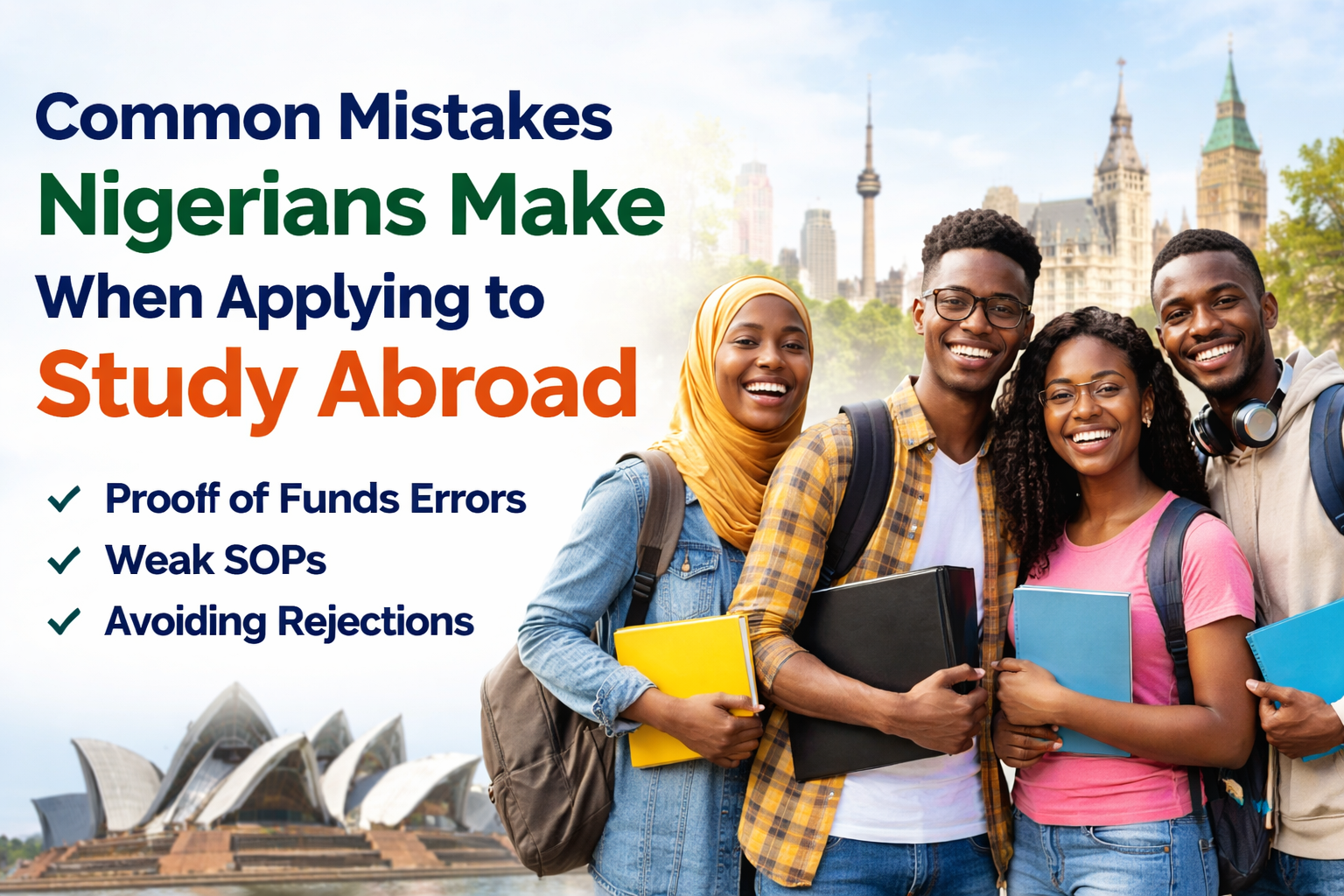
This is a practical, step-by-step guide you can actually follow. No “guaranteed visa” talk. No shortcuts. Just what works when you do it properly and how to fix the Common Mistakes Nigerians Make When Applying to Study Abroad without panic.
What You’ll Learn
- Why Nigerians get stuck during study abroad applications (and how to avoid it)
- How to plan money, proof of funds, and hidden costs without panic
- How to choose a country and course that matches your profile
- How to write a strong SOP that sounds like you (not a template)
- Country-specific pitfalls for the UK, Canada, Germany, the US, and Australia
- Simple checklists and tables you can use as you apply
Disclaimer: Study abroad rules are controlled by governments and universities, and requirements may change. Always confirm the latest information on official websites before you apply or pay any fees.
Official sources used in this article (bookmark these):
- UK Student visa (gov.uk)
- UK Student visa: money you need (gov.uk)
- Canada study permit (IRCC)
- Canada proof of financial support amounts (IRCC)
- US Student visas (travel.state.gov)
- US I-20 + SEVIS basics (Study in the States)
- Germany proof of financing (Study-in-Germany.com)
- Australia Genuine Student requirement (homeaffairs.gov.au)
Common Mistakes Nigerians Make When Applying to Study Abroad: Step-by-Step Fixes
To make this easy to follow, we’ll go step by step. Each step covers a real mistake, why it happens, how it hurts, and what to do instead. If you want a single thing to remember: Common Mistakes Nigerians Make When Applying to Study Abroad are usually not “big disasters” they’re small gaps in planning that pile up.
Step 1: Choosing a Country Because It’s Trending (Not Because It Fits You)
Why it happens: people follow the crowd. When everyone is shouting “Canada!” or “UK is faster!”, it’s easy to copy someone else’s plan without checking your own reality.
How it hurts you: you may pick a country that doesn’t match your budget, grades, or timeline. Then you start forcing the process, and that’s where trouble begins.
Fix: decide based on your reality, not hype. Write down four things before you even choose a country:
- Your total budget in naira (and how you’ll handle exchange rate changes).
- Your academic profile (class of degree/GPA, transcripts, WAEC/NECO, work experience).
- Your career goal (e.g., nursing, data, cybersecurity, engineering, finance, consulting).
- Your timeline (next intake you can realistically meet).
Real example: Tolu in Lagos wants “any MSc” in Canada because friends are there. But his budget only covers tuition, not living costs. He switches to a lower-cost city option and applies early less pressure, better chances. That’s how you avoid one of the Common Mistakes Nigerians Make When Applying to Study Abroad.
Step 2: Applying to Too Many Schools Without Proper Research
Why it happens: anxiety. Many students think “the more schools I apply to, the safer I am.” But random applications are expensive.
How it hurts you: wasted fees, mismatched programs, missing entry requirements, and weak application quality because you’re rushing.
Fix: shortlist smartly (4–8 schools max):
- 2 “safe” options
- 4 “match” options
- 2 “reach” options
Use official portals and real university pages (not screenshots from Telegram):
Internal helpful reads: Study Abroad Checklist and How to Choose a University.
If you’ve ever applied to 12 schools and still felt lost, you’ve experienced the Common Mistakes Nigerians Make When Applying to Study Abroad in real life too many applications, not enough strategy.
Step 3: Messy Proof of Funds (The Quiet Visa Killer)
Why it happens: people underestimate how serious financial credibility is. Some applicants try to “arrange” money last minute. That often creates questions you don’t want.
How it hurts you: even if you have money, unclear source or timing can look suspicious. Visa decisions are heavily influenced by whether your funding story makes sense.
Fix: treat proof of funds like a story that must be consistent from start to finish SOP, sponsor letter, bank statements, and tuition plans should align. This is one of the most common reasons behind the Common Mistakes Nigerians Make When Applying to Study Abroad.
UK (example)
The UK financial requirement depends on where you study. The official government page lists monthly amounts for London vs outside London. Always confirm the latest amounts directly on gov.uk. See: UK Student visa: money you need.
Canada (example)
IRCC lists annual living expense amounts (excluding tuition and transportation) based on family size. For one person, the official figure shown is CAN$22,895 per year (outside Quebec). See: IRCC proof of financial support.
Germany (example)
Germany commonly requires proof you can support yourself, and the Study-in-Germany site references 11,904 euros in many cases. See: Proof of financing (Germany).
Safe, legal ways Nigerians handle funding:
- Personal savings (kept stable and well-documented)
- Sponsor support (with clear relationship + sponsor income evidence where required)
- Recognized student loans / education loans (with official approval letters)
- Scholarships (official award letters)
Internal link: Proof of Funds Guide.
Step 4: Forgetting Hidden Costs (Forex Will Surprise You)
Why it happens: people budget for tuition and visa fee only. Then “small costs” stack up until you’re overwhelmed.
How it hurts you: you get an admission offer… then can’t move because of deposits, flights, and setup costs.
Fix: budget beyond tuition. You should plan for:
- Visa fees + biometrics
- Medical exam / TB test (where required)
- Housing deposit + first month rent
- Flight tickets
- Health insurance / travel insurance
- International money transfer fees
- Emergency funds (at least 2–3 months of basic living)
This is another place where the Common Mistakes Nigerians Make When Applying to Study Abroad shows up: students win admission, then lose momentum because they didn’t plan the landing costs.
Step 5: Late Documents (Nigeria Delays Are Real)
Why it happens: transcripts, reference letters, and official documents can take time in Nigeria. Some schools are fast; some are not.
How it hurts you: you miss deadlines or submit incomplete applications.
Fix: request documents early especially transcripts. Keep scanned copies in a cloud folder plus a physical folder. Late documents are one of the Common Mistakes Nigerians Make When Applying to Study Abroad that people don’t take seriously until it’s too late.
Step 6: Weak SOP / Study Plan (Or Copying Templates)
Why it happens: people think the SOP is “just a formality.” It’s not.
How it hurts you: a generic SOP doesn’t explain your choices. Worse, it may contradict your academic history.
Fix: write like a real person. Use this simple structure:
- Your background (short, true)
- Why this course (skills gap + logical progression)
- Why this country (education + career relevance)
- Why this school (specific program features)
- What you’ll do after (realistic career plan)
- How you’ll fund it (consistent with documents)
Real example: Aisha studied Accounting in Nigeria and applies for Financial Technology in the UK. She explains the bridge: accounting → finance systems → fintech tools → roles like compliance, analytics, or product operations. It makes sense, so the story feels believable. A copied SOP would have looked like one of the Common Mistakes Nigerians Make When Applying to Study Abroad.
Step 7: Applying Too Late (Deadlines Don’t Care)
Why it happens: people underestimate how long the full process takes research, tests, offers, visa, and travel.
How it hurts you: you end up rushing SOP, rushing funds, and missing visa appointment windows.
Fix: use this timeline as your baseline:
| Stage | Recommended Timeline Before Resumption |
|---|---|
| Research & shortlist | 9–12 months |
| Tests (IELTS/TOEFL/PTE if needed) | 6–10 months |
| Applications + documents | 6–9 months |
| Offers + deposit planning | 4–6 months |
| Visa application | 3–4 months |
| Housing + flight + insurance | 1–2 months |
When you follow this timeline, you avoid the Common Mistakes Nigerians Make When Applying to Study Abroad that come from rushing everything at the end.
Step 8: Ignoring Insurance and Health Rules
Why it happens: it feels like “extra.” But some countries require it, and even when they don’t, it protects you during travel and settling in.
Fix: confirm health and insurance requirements on official government pages and budget early. It’s part of responsible planning and helps you avoid another one of the Common Mistakes Nigerians Make When Applying to Study Abroad.
Step 9: Depending on an “Agent” Without Understanding Your Own Application
Why it happens: the process feels stressful, so people outsource everything.
How it hurts you: if something goes wrong, you can’t defend your own application because you don’t know what was submitted.
Fix: even if you get help, you must know your documents, your funding story, and your SOP. Keep your own copies of everything. This is a big part of avoiding the Common Mistakes Nigerians Make When Applying to Study Abroad.
Step 10: A Weak “Why” (Gaps, Career Switches, and Unclear Direction)
Why it happens: life happens strike, NYSC delays, family issues, job changes. But people don’t explain gaps well.
Fix: explain gaps calmly with evidence (work letter, training certificates, NYSC timelines, business registration). You’re not hiding anything you’re clarifying.
Country-Specific Pitfalls Nigerians Should Watch
UK
- Misunderstanding the financial requirement amounts (check official gov.uk pages).
- Forgetting TB test requirements where applicable: UK TB test guidance.
- Not aligning SOP/course choice with your academic history.
Canada
- Weak proof of financial support or missing documents: IRCC financial support.
- Study plan that doesn’t explain “why this program, why now.”
- Late timelines and rushed applications.
Germany
- Underestimating living costs and proof of financing expectations: Proof of financing.
- Not arranging health insurance properly.
USA
- Not understanding the basics of Form I-20 and SEVIS: Study in the States (DHS).
- Weak interview preparation and inconsistent answers.
Australia
- Not addressing the Genuine Student requirement properly: Genuine Student requirement.
- Course mismatch (applying for something unrelated without a clear explanation).
Quick Comparison Table: Common Triggers That Lead to Problems
| Problem Trigger | What It Looks Like | Simple Fix |
|---|---|---|
| Rushed proof of funds | Big last-minute deposits, unclear source | Plan early; keep funds stable; document source |
| Generic SOP | Copied template, no clear career path | Write your real story with a logical progression |
| Late timeline | Applying near resumption date | Start 9–12 months early; follow a timeline |
| Incomplete documents | Missing transcripts, references, or IDs | Request documents early; keep a checklist |
FAQ (AEO-Friendly: Short, Direct Answers)
Is it easier to get a student visa from Nigeria?
No country is “easy.” Approval depends on meeting official requirements, credible documentation, and a consistent study plan. Always verify rules on official government sites.
Can I use an education loan for proof of funds?
Often, yes if it’s a legitimate loan from a recognized institution and the documentation is clear. Confirm acceptable documents on the official immigration site for your country (e.g., IRCC for Canada).
Do I really need health insurance?
Many destinations require it, and even when not strictly required, it’s strongly recommended. Confirm your destination’s rules on official sources.
How long does the whole process take?
Most Nigerians should plan for 6–12 months from research to visa, depending on destination and intake.
What’s one quick way to avoid rejections?
Start early and keep your story consistent. Most Common Mistakes Nigerians Make When Applying to Study Abroad happen when people rush or submit documents that don’t match their SOP.
Should I use an agent?
You can get help, but you must still understand your own application and keep copies of everything. Never submit anything you can’t explain.
Final Advice (Straight Talk)
Applying to study abroad from Nigeria is not just paperwork it’s a planning test.
If your plan is “I’ll figure it out later,” you’ll spend more money and face more stress.
If your plan is “I’ll do it properly, step by step,” you’ll still face challenges but you’ll avoid the Common Mistakes Nigerians Make When Applying to Study Abroad that ruin good applications.
Your next actions this week:
- Pick one country and read the official student visa page fully (use the links above).
- Create a one-page budget (tuition + living + visa + housing + insurance + flight + emergency funds).
- Start requesting transcripts and references now.
- Draft your SOP outline using the simple structure in this article.
And please remember: taking one extra intake to do it right is better than rushing and losing money.
Internal Links (Add/Replace With Your Site Pages)
- Study Abroad Checklist
- Proof of Funds Guide
- How to Register for IELTS in Nigeria
- Best Countries to Study Abroad From Nigeria
Author Bio
Author: James
James writes practical study-abroad and relocation guides for Nigerians, with a focus on official government requirements, realistic budgeting,
and step-by-step planning. This article uses verified official sources (gov.uk, IRCC/canada.ca, travel.state.gov, Study in the States,
Study-in-Germany, and Australia’s Department of Home Affairs) and real Nigerian scenarios to help readers avoid costly mistakes.


 Chiprince

 Lucky Okezie