 Chiprince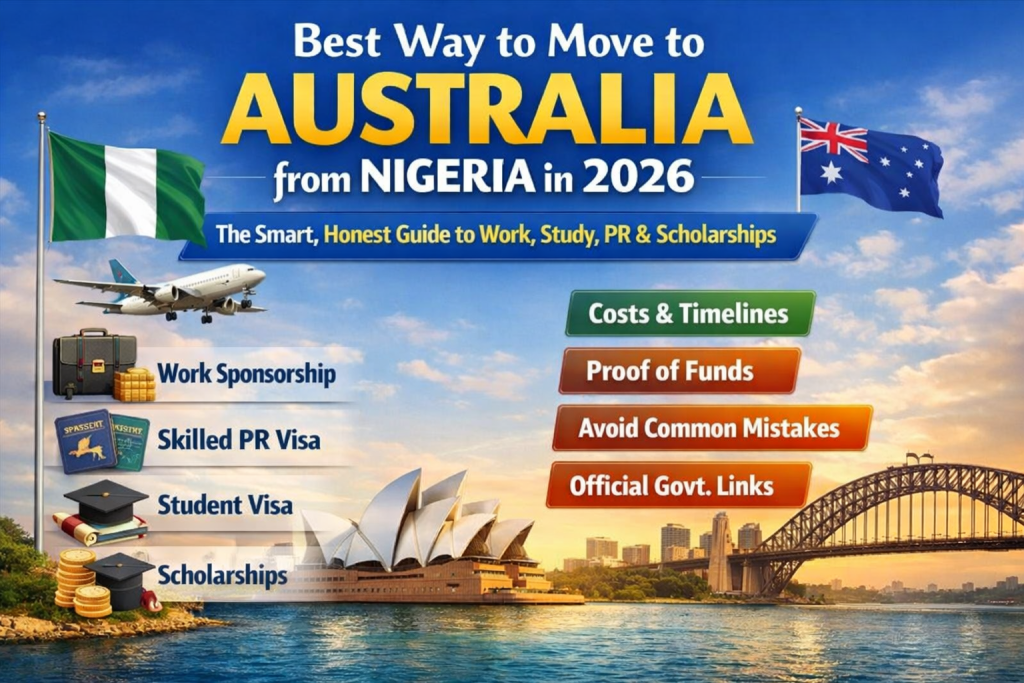
Best Way to Move to Australia from Nigeria that’s what a lot of people type late at night, especially after one more fuel price conversation, one more “salary can’t cover life” month, or one more security story that shakes you.
If you’re in Umuahia, Lagos, Abuja, Port Harcourt (or anywhere across Nigeria and Africa) wondering how people genuinely make this move, you’re not alone.
Australia is attractive for real reasons: better earning potential in some sectors, safer cities, strong healthcare, and clearer long-term settlement options compared to many places.
But let’s be honest upfront: Australia is not a “land and figure it out” country.
It’s evidence-based. The government and employers want paperwork that proves your story makes sense skills, finances, study plan, work history and they can be strict.
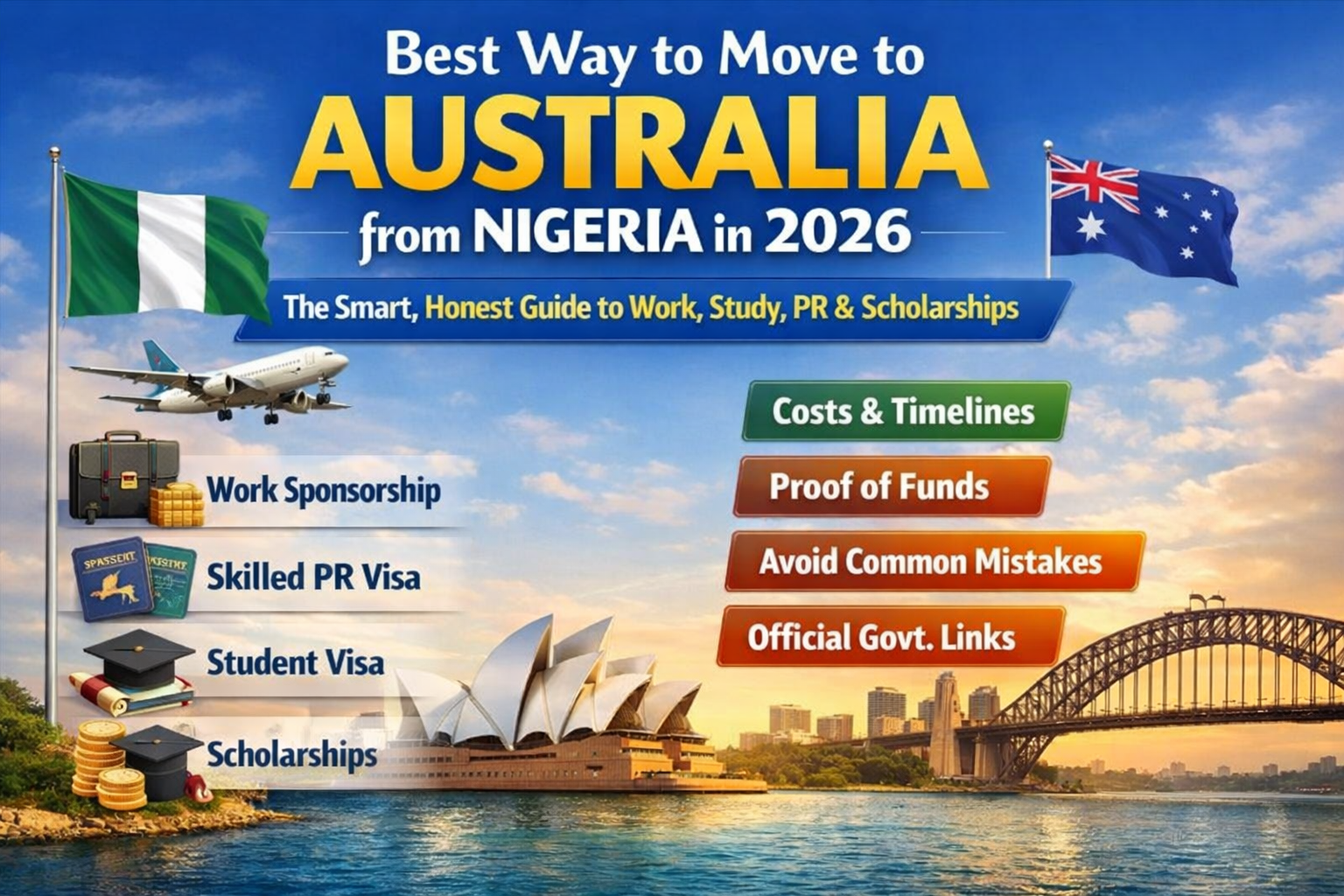
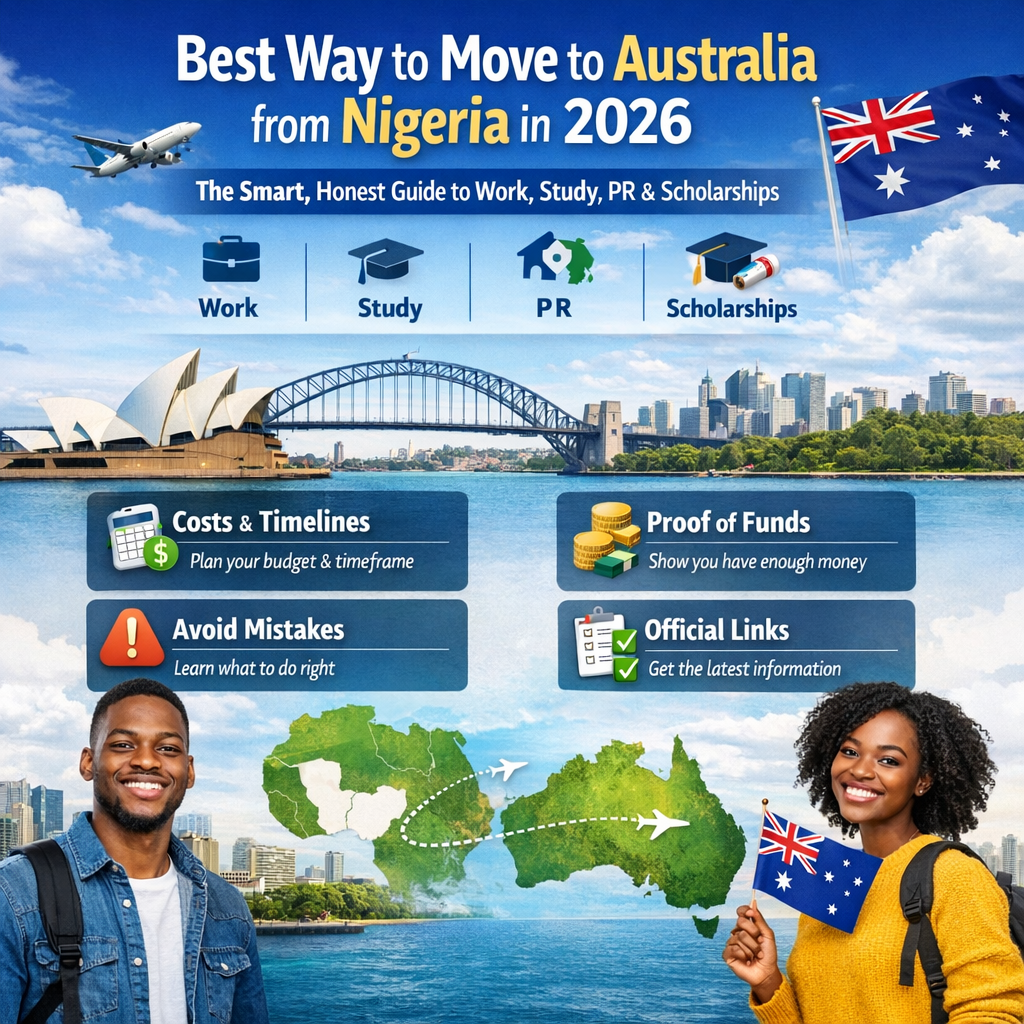
This is a practical breakdown of the Best Way to Move to Australia from Nigeria in 2026 using four realistic routes: Work, Study, Permanent Residency (PR), and Scholarships.
You’ll see the why, the how, and the when plus the mistakes that waste money.
What you’ll learn
- The four main pathways Nigerians use to move to Australia and who each one fits.
- Why employer sponsorship can be the fastest route if you’re competitive.
- How skilled migration (PR) actually works and why “65 points” isn’t the full story.
- How to use the study route without getting refused under the Genuine Student requirement.
- The most credible scholarship route for Africans and when to apply.
- A step-by-step action plan: documents, budgeting, timelines, and scams to avoid.
- Nigeria specific tips for proof of funds, banking, and your first 30 days in Australia.
Disclaimer (please read)
This guide is educational and based on official information available as of February 2026. Immigration rules, costs, occupation lists, and processing settings can change quickly, and requirements may change.
Always verify details on official Australian government websites before paying any fees or submitting an application.This is not legal advice, and nobody can guarantee a visa outcome. If you use a migration agent, the Australian Government recommends using registered agents and checking the official register:
Using a migration agent (Home Affairs) and
OMARA migration agent register.
Quick navigation
- Step-by-step plan
- Route comparison table
- Route 1: Work (Employer sponsorship)
- Route 2: PR (Skilled migration)
- Route 3: Study (Student visa)
- Route 4: Scholarships
- Documents checklist
- Costs & budgeting
- Timelines
- Mistakes to avoid
- FAQ
- Final advice
Step-by-step: Best Way to Move to Australia from Nigeria (2026 plan)
Step 1: Be clear about your goal (because “best” depends on your situation)
The Best Way to Move to Australia from Nigeria is not one single visa. It’s the route you can realistically prove.
Before you choose anything, answer these four questions (truthfully no vibes):
- Why Australia for you? (career growth, safety, family future, education, stability)
- How soon do you want to leave Nigeria? (3–6 months vs 12–24 months)
- What can you prove on paper today? (skills, work history, English, savings)
- What’s your real budget? (self-funded, sponsor, education loan, scholarship)
Here’s the blunt truth: a 23-year-old graduate with limited experience often has an easier entry through study (if funded properly),
while a 35-year-old engineer with strong experience may do better through work sponsorship or a PR strategy.
If you want to organize your documents like a serious applicant (not a rushed one), this internal guide from Travel & Tour helps:
Admission Requirements for Nigerian Students Studying Abroad.
Step 2: Understand the four realistic routes (Work, PR, Study, Scholarships)
Let’s simplify it. Below is the cleanest comparison for Nigerians choosing a route in 2026.
| Route | Best for | Why people choose it | Hard truths | Official starting link |
|---|---|---|---|---|
| Work (Employer sponsorship) | Experienced professionals in in-demand roles | Move with a job; earn sooner | You must be competitive; not all employers sponsor | Skills in Demand visa (subclass 482) |
| PR (Skilled migration) | Strong points + listed occupation + skills assessment | Best long-term stability | Invitations are competitive; minimum points doesn’t guarantee invitation | SkillSelect |
| Study | Younger applicants, career changers, people building skills | Clear entry route + Australian qualification | Costly; you must satisfy Genuine Student + show funds | Student visa (subclass 500) |
| Scholarships | Mid-career candidates with leadership + impact | Can be fully funded and highly credible | Competitive; slow timelines; strict deadlines | Australia Awards Africa (Apply) |
Now let’s break them down properly what they mean, how Nigerians actually succeed, and when each route makes sense.
Route 1: Work (Employer sponsorship) – often the fastest if you qualify
What it is
Employer sponsorship is a straight line: an Australian employer needs your skills and sponsors your visa.
The official entry point most people start from is the Skills in Demand visa (subclass 482):
Home Affairs: 482 visa.
Why it can be the best route (when it works)
Because you’re moving for a real job not paying international tuition first. That usually means:
you start earning sooner, you settle faster, and your reason for moving is easy to explain.
For many people, that’s the Best Way to Move to Australia from Nigeria because it reduces financial pressure.
Who this route fits (honest version)
- You have 3+ years solid experience (more is better).
- You work in a clear skill area: tech, engineering, healthcare, or niche finance roles.
- You can prove impact results, tools, projects, outcomes, references.
How to pursue employer sponsorship from Nigeria (real steps)
- Fix your CV to Australian expectations. Use achievements, not only responsibilities.
- Build proof. Portfolio (tech), project lists (engineering), registration steps (healthcare), certifications where relevant.
- Apply selectively. Target roles where your skills match strongly (don’t waste time on roles that clearly don’t fit).
- Be upfront about sponsorship. Employers prefer clarity over surprises late in the process.
- Keep your documents ready. Passport, references, certificates, and an updated LinkedIn profile.
Three Nigerian examples (what “competitive” looks like)
Example 1: Tunde (Lagos) software engineer.
Tunde had 4 years of backend experience, but his CV was just “I worked on APIs.”
He rebuilt it to show outcomes: “reduced response time by 35%,” “built payment integration used by 50k users,” and linked a small GitHub portfolio.
He started getting interviews because the employer could see what they were buying.
Example 2: Ifeoma (Abuja) accountant/finance.
Finance roles can be competitive. Ifeoma focused on niche strengths: compliance, reporting systems, and measurable cost controls.
She applied to fewer roles, but tailored each application. Her advantage wasn’t “I want to relocate,” it was “I can reduce risk and improve controls.”
Example 3: Sani (Port Harcourt) mechanical technician.
Sani documented equipment types, safety procedures, and measurable maintenance outcomes.
He also gathered strong reference letters early (this matters more than people think).
Even when opportunities were limited, his documentation made him credible.
Common mistakes Nigerians make (and how to avoid them)
- Mistake: Paying someone to “get you a sponsor.”
Fix: Treat that as a red flag. Sponsorship is employer-driven. - Mistake: Sending the same CV to 200 jobs.
Fix: Send fewer applications but tailor them properly. - Mistake: Having no proof beyond job title.
Fix: Create a proof pack: projects, metrics, references, certifications.
Route 2: PR (Skilled migration) strongest long-term, but competitive
What it is
Skilled migration is where your profile is scored (points), your occupation is assessed, and you may receive an invitation.
The government portal for the process is SkillSelect:
Home Affairs: SkillSelect.
Why people love it
PR is stability. It’s usually the strongest long-term status if your goal is settling, building a family future, and not being tied to one employer.
That’s why many Nigerians consider this the Best Way to Move to Australia from Nigeria but only if their profile is strong.
The hard truth about points
People hear “65 points” and think “that’s enough.”
Officially, 65 is the baseline to be eligible for the points-tested stream, but eligibility is not the same as being invited.
Start here:
Skilled Independent 189 (points-tested).
To understand the scoring properly, use the official points table:
Points table (189).
How the PR pathway works (simple but accurate)
- Confirm your occupation pathway. Not every job fits PR routes the same way.
- Get the correct skills assessment. The assessing authority depends on your occupation.
- Improve English if needed. Better English can improve points and competitiveness.
- Submit an EOI (Expression of Interest). Official EOI guidance:
EOI guide. - Wait for invitation or explore state/region pathways. This is where patience matters.
Two Nigerian examples (how people avoid wasting years)
Emeka (Lagos) civil engineer.
Emeka got serious about documents early: transcripts, reference letters, and consistent work history.
He didn’t submit an EOI with guesswork. He treated it like a bank loan file everything consistent and verifiable.
That approach reduces errors and delays.
Kemi (Benin City) data analyst.
Kemi realized her first plan wasn’t competitive enough. Instead of forcing a weak PR application, she improved her English score and gained more relevant experience.
Sometimes the best move is to pause and build points before you spend money.
Common mistakes (and fixes)
- Mistake: Using unofficial calculators and building false hope.
Fix: Use official points tables and guidance pages. - Mistake: Spending money before confirming the right occupation path.
Fix: Confirm eligibility first, then spend. - Mistake: Putting your life on hold waiting for one outcome.
Fix: Keep a Plan B (work sponsorship or study).
Route 3: Study (Student 500) common entry route, but must be done cleanly
What it is
The Student visa (subclass 500) allows you to study in Australia if you’re enrolled and meet requirements.
Official page:
Home Affairs: Student visa 500.
After eligible study, some graduates may apply for the Temporary Graduate visa (subclass 485).
Official page:
Home Affairs: Temporary Graduate 485.
The biggest rule: Genuine Student (GS)
Australia assesses whether you are a genuine student. If your story looks like “I’m using school as a cover,” refusal is possible.
Read the official requirement here:
Genuine Student requirement.
Proof of funds (the number Nigerians keep asking about)
Australia updated the student visa financial capacity requirement. The official Home Affairs archive states the updated amount is AUD 29,710 (living cost component for a primary applicant):
Financial capacity requirement update.
Study Australia also summarizes this change and points applicants back to Home Affairs:
Study Australia: visa changes summary.
Hard truth: student visa refusals often happen because the money story doesn’t look believable.
Sudden deposits, unclear sponsors, inconsistent bank history these can raise questions.
If you’re using an education loan, keep it legitimate and documented.
If family is sponsoring, keep the paper trail clean.
How to do the study route properly from Nigeria (step-by-step)
- Pick the course logically. It should connect to your background or a believable career pivot.
- Apply to reputable schools. Avoid “too good to be true” institutions.
- Get your offer and Confirmation of Enrolment (CoE).
- Write your GS story like a human. Why this course, why this school, why now, how it fits your career.
- Show financial capacity clearly. Tuition + living costs + travel, with clean documentation.
- Apply via ImmiAccount and upload documents carefully.
Study route done right
Zainab (Kano) career switch into data.
Zainab didn’t pick a random diploma. She selected a program aligned with her career plan, prepared proof of funds with consistent bank history,
and wrote a GS statement that read like a real student, not a panic move.
Samuel (Abuja) Master’s with sponsor support.
Samuel’s sponsor (his uncle) had funds, but the money moved between accounts too frequently.
They simplified it: one clear sponsor account, stable statements, and a straightforward explanation.
That kind of clarity reduces stress and risk.
Amaka (Lagos) nursing pathway planning.
Amaka didn’t rush. She researched registration steps, chose a program that made sense for her background,
and planned finances early. She treated it like a one-year project, not a one-week rush.
For scholarship strategy alongside study planning, this internal guide can help:
Fully Funded Scholarships Nigerians Can Apply for in 2026.
Route 4: Scholarships life-changing, but competitive
Australia Awards (Africa)
If you’re asking, “Is there a real government scholarship route?” Yes. Australia Awards is one of the most credible.
For Africa applicants, start here:
Australia Awards Africa apply page.
For official opening and closing dates, DFAT publishes details here:
DFAT Australia Awards opening/closing dates.
DFAT also provides an official PDF with benefits and process:
Australia Awards Africa: intake information (PDF).
Why scholarships are hard (but still worth it)
They’re selective on purpose. They usually reward strong academics, relevant work experience, leadership, and a credible “return and impact” plan.
If you’re early-career with little track record, it’s not impossible, but the competition is higher.
Best “when” advice: Apply early, and don’t pause your entire life waiting.
Build a Plan B (work or study) while you apply.
Documents checklist Nigerians should prepare early
If you want the Best Way to Move to Australia from Nigeria to work for you, treat your documents like an audit file.
Most rejections and delays come from weak evidence, not from “bad luck.”
| Document | Why it matters | Nigeria reality tip | Relevant official link |
|---|---|---|---|
| Passport | Identity + travel | Renew early; don’t wait for “offer first.” | Australia High Commission (Nigeria): travelling to Australia |
| CV + reference letters | Needed for work routes + credibility | Use letterhead, real contacts, consistent dates and roles. | Official guidance: who can help |
| Academic certificates/transcripts | Proof of education | Request early; transcripts can take weeks in Nigeria. | Student visa (500) |
| Proof of funds (study route) | High-risk refusal area | Avoid sudden deposits; document sponsor and sources. | Official funds requirement update |
| Migration agent verification (if using one) | Protects you from scams | Verify the agent on the official register before paying. | OMARA register |
If you want a clean, Nigeria-specific “application folder” approach, use this internal guide:
How to Apply to Foreign Universities from Nigeria (2026).
Even though that post is broader than Australia, the document discipline applies perfectly here.
Costs & budgeting (Nigeria realities, explained)
Let’s be very honest: moving to Australia costs money.
Even if you get approved, the first month can humble you rent bond, transport, groceries, and settling in.
So budgeting is not “extra.” It’s part of the plan.
For visa fees, don’t rely on screenshots or random social media numbers. Australia provides an official estimator:
Visa Pricing Estimator.
Use it as a planning tool.
What Nigerians usually spend money on (by route)
- Work sponsorship: document prep, possible skills checks, flights, initial settlement.
- PR: skills assessment, English test, document costs, visa fees, waiting time costs.
- Study: tuition deposit, proof of funds, living costs, travel, and compliance planning.
- Scholarship: less upfront fees, but more time and documentation effort.
Cost planning table (not a promise, a planning tool)
| Cost item | Typical cost | Notes for Nigerians | Official reference |
|---|---|---|---|
| Visa application charge | Varies | Use the estimator for your visa type and dependants. | Visa Pricing Estimator |
| Student funds evidence | AUD 29,710 (living cost component) | This is a key figure to plan around, plus tuition and travel. | Financial capacity update |
| First-month settlement | Varies | Expect rent bond + transport + basic setup to be heavy upfront. | (Personal budgeting) |
Proof of funds (Nigeria tip): Keep your money story clean. If your sponsor is paying, show the relationship and consistent account history.
Avoid last-minute deposits that create questions. If using an education loan, keep documentation complete and traceable.
Money transfer tip: Use reputable banks and regulated transfer services. Keep receipts for tuition deposits and major payments.
Clean records reduce stress later.
Timelines (when to start what)
People ask: “How long does it take?” The honest answer: it depends on your route and how prepared you are.
Australia provides an official processing time tool:
Global visa processing times.
Always check close to your application date.
| Stage | Suggested timeline (Nigeria) | Why this timing helps |
|---|---|---|
| Choose route + confirm official requirements | Week 1–2 | Stops you from spending money before you understand the correct pathway. |
| Documents + CV + transcripts + references | Week 1–8 | Reduces panic and avoids rushed, inconsistent documents. |
| Study applications (if studying) | Month 2–6 | Gives time for offers, CoE, and clean funds planning. |
| PR planning / EOI accuracy work | Month 2–6+ | PR is competitive; accuracy and patience matter. |
Best “when” advice: If you want a 2026 move, start now not because you’re late, but because you need buffer time for Nigerian delays and clean preparation.
Common mistakes Nigerians make (and how to avoid them)
1) Choosing the “easy-sounding” route instead of the provable route
The Best Way to Move to Australia from Nigeria is the one your documents can support. Not the one your friend used.
Start with evidence, then choose the route.
2) Paying unverified agents and “consultants”
If someone promises “guaranteed visa,” run. If you want professional help, verify the agent on the official register:
OMARA register.
3) Weak study plan (Genuine Student issues)
For student visas, your story must read like a real student: why the course, why now, why this school.
Official GS guidance:
Genuine Student requirement.
4) Messy proof of funds
Funds are not only about having money. They’re about having a believable, documented story.
Use the official funds update as your base reference:
Financial capacity requirement update.
5) Guessing fees and timelines
Use the official tools:
Visa Pricing Estimator and
Global processing times.
FAQ (AEO-friendly, short and direct)
What is the best way to move to Australia from Nigeria in 2026?
If you already have strong, in-demand skills and experience, employer sponsorship can be the most direct.
If long-term settlement is your priority, skilled migration PR routes can be strong but are competitive.
Can I move through school?
Yes, through the Student visa (subclass 500). But you must meet the Genuine Student requirement and show financial capacity.
Start with:
Student visa 500 and
Genuine Student requirement.
Is 65 points enough for PR?
65 points may be the minimum eligibility threshold for some points-tested streams, but invitations depend on competition.
Official starting point:
Skilled Independent 189 (points-tested).
How much money do I need to show for a student visa?
A key figure is AUD 29,710 (living cost component for a primary applicant), plus tuition and travel costs.
Official update:
Financial capacity requirement update.
How do I estimate visa fees?
Use the official estimator:
Visa Pricing Estimator.
How do I avoid fake migration agents?
Verify any agent on:
OMARA register.
Final advice (realistic and trust-building)
If you remember one thing, make it this:
The Best Way to Move to Australia from Nigeria is the route you can prove not the route that sounds easiest.
- If you’re experienced and in-demand: pursue employer sponsorship first, while building PR readiness.
- If you’re still building your profile: study can work, but only with a credible plan and realistic finances.
- If you’re scholarship-caliber: apply early, and keep building a Plan B while you wait.
Your “start today” checklist
- Pick your primary route: Work / PR / Study / Scholarship.
- Create one clean folder with passport, CV, references, transcripts, and funds evidence.
- If studying: map tuition + funds properly and read the Genuine Student requirement.
- If PR: read the points-tested guidance and submit only when your data is accurate.
- Use official tools for fees and processing times before you pay for anything.
Official sources (clickable)
- Australian Department of Home Affairs
- Skills in Demand visa (subclass 482)
- SkillSelect
- Expression of Interest (EOI)
- Skilled Independent 189 (points-tested)
- Points table (189)
- Student visa (subclass 500)
- Genuine Student requirement
- Financial capacity requirement update (AUD 29,710)
- Visa Pricing Estimator
- Global visa processing times
- Australia Awards Africa (Apply)
- DFAT: Australia Awards opening/closing dates
- DFAT: Australia Awards Africa intake PDF
- Using a migration agent (Home Affairs)
- OMARA migration agent register
Author bio
Author: Travel & Tour Research Writer (Nigeria Focus)
I write practical visa, travel, and study-abroad guides for Nigerians using official government and university sources as primary references.
This article was built by cross-checking Australian Department of Home Affairs pages (visa types, Genuine Student requirement, financial capacity updates, pricing estimator, processing times), DFAT scholarship guidance, and reputable scholarship portals then translating those rules into step-by-step actions Nigerians can realistically follow.


 Lucky Okezie
 Chiprince