 Chiprince
Quick answer
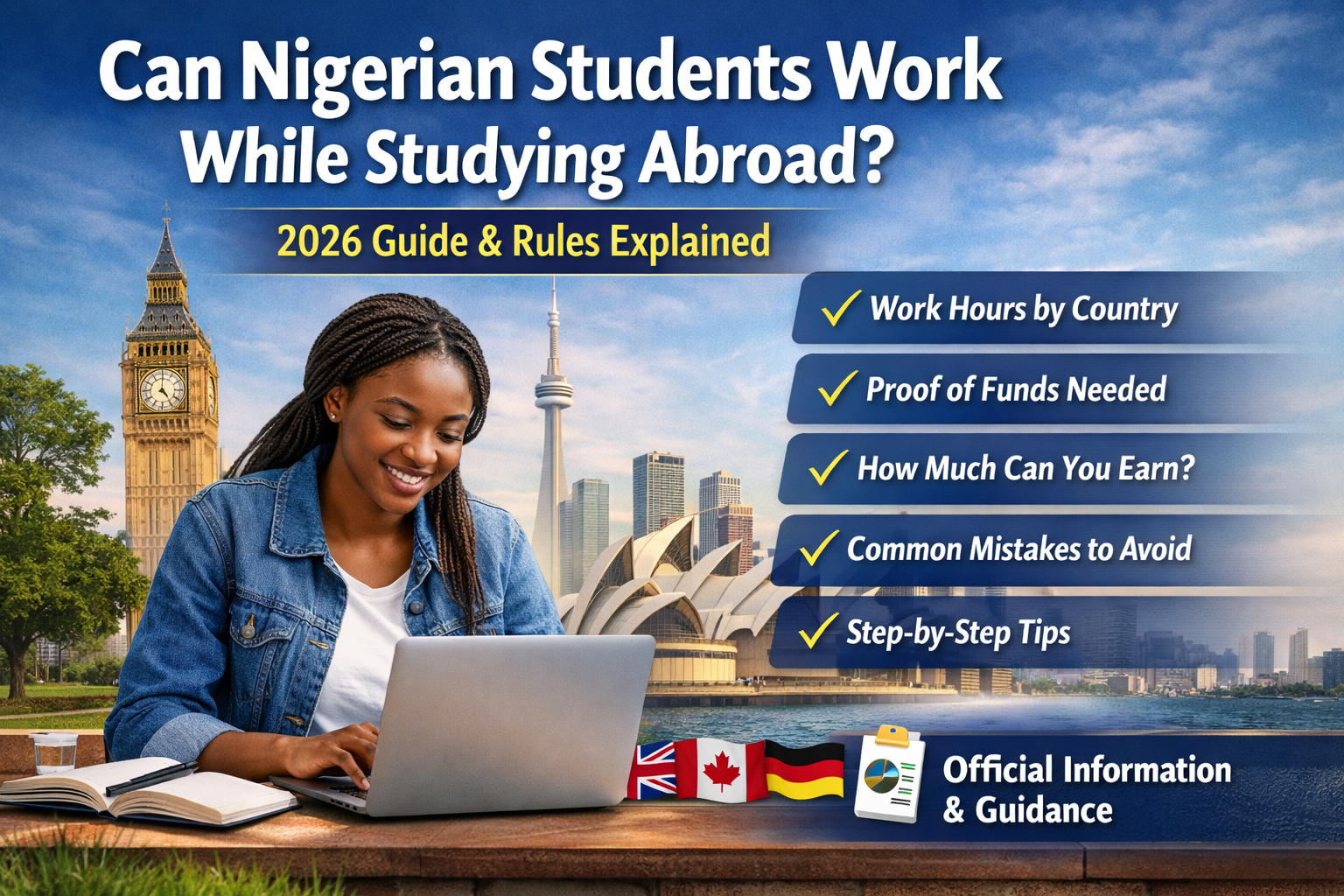
Can Nigerian students work while studying abroad?
Yes, but with limits. In the UK, many degree students can work up to 20 hours/week during term. In Canada, eligible students can work up to 24 hours/week during classes. In the USA, F-1 students usually work on-campus only in their first academic year (up to 20 hours/week), with off-campus work only through authorized routes like CPT/OPT. In Australia, student visa holders can work up to 48 hours per fortnight while the course is in session. In Germany, non-EU/EEA students can work 140 full days / 280 half-days per year (or up to 20 hours/week during lectures, depending on how it’s counted). (Canada)
What you’ll learn
- Whether Can Nigerian students work while studying abroad is true for the UK, Canada, USA, Australia, and Germany
- Exactly how many hours you’re allowed to work (and how “holiday” is defined)
- Which jobs are allowed and what can get you into trouble
- What you can realistically earn (and what it can cover)
- Why proof of funds still matters even if you plan to work
- A practical step-by-step plan to start working legally
- Common mistakes Nigerian students make (and how to avoid them)
- Tables + checklists you can save and use
Disclaimer (please read)
This guide is for education and planning. It is not legal advice. Immigration policies vary by country and sometimes by school/program. Requirements may change at any time.
Before you apply for a visa or accept a job, confirm the latest rules on official government websites and with your university’s international student office.
The short answer: Yes, but it’s not “work and pay everything”
In most popular destinations, international students are allowed to work part-time during school and more hours during scheduled breaks.
But these points matter:
- Your student visa/permit must allow work
- You must follow hour limits (no “averaging” your way out)
- You often can’t be “self-employed” or run a business on a student visa (country-dependent)
- Part-time income usually helps with living costs, not full tuition
- Proof of funds usually must show you can pay without depending on work
Canada is extremely clear about the “don’t depend on work” idea: students must show they can support themselves under official financial requirements, and work limits are enforced. (Canada)
So yes – Can Nigerian students work while studying abroad? Absolutely. But you need a plan that works even if you don’t get a job in your first month.
Who this guide is for
This is for Nigerians going for BSc, MSc, PhD, diploma, foundation/pathway programs, and anyone planning to travel from Nigeria to study in the UK, Canada, USA, Australia, or Germany.
If you haven’t applied yet, also read your site’s guide on applying properly (it’s a strong foundation and helps you avoid expensive mistakes):
“How to Apply to Foreign Universities from Nigeria (2026 Guide)”
(Travel & Tour)
And if you’re still choosing a course, this one helps you pick programs with real outcomes:
“Best Courses to Study Abroad for Nigerian Students (2026)”
(Travel & Tour)
Country-by-country: Can Nigerian students work while studying abroad?
United Kingdom (UK Student visa)
Official references: UKCISA student work rules and GOV.UK student route pages (UKCISA)
Work limit (common for degree-level study)
For many full-time degree-level students, the limit is commonly:
- Up to 20 hours per week during term time
- Full-time during official vacations (UKCISA)
Important UK reality Nigerians should know:
Some Master’s students have no long summer break because dissertation periods may still count as “term time” depending on the university. Don’t assume “summer = free work time.” Always confirm your school’s official term dates. (University of Greenwich)
What you usually can’t do
Restrictions depend on your specific visa conditions, but commonly include no self-employment and limits around professional sports. UKCISA explains student work restrictions and warns students to check their conditions carefully. (UKCISA)
The hard truth (UK)
In the UK, part-time work can help with:
- groceries
- transport
- part of rent (especially outside London)
But it won’t magically pay £15,000 – £30,000 tuition. A realistic plan often combines:
- savings/sponsorship
- scholarships
- education loans (responsibly)
- part-time work as support
Dependants (important update)
If you planned to travel with family, UK dependant eligibility tightened for many postgraduate taught courses starting on/after 1 January 2024. Check the official GOV.UK dependant rules.
(GOV.UK)
Canada (Study permit)
Official references: IRCC / Canada.ca work rules and help Centre (Canada)
Work limit (current official rule)
If eligible, Canada’s official rule says you can work:
- Up to 24 hours per week off-campus during regular academic sessions
- Unlimited hours during scheduled breaks (Canada)
Canada is also very direct about consequences: working more than allowed can violate your study permit conditions and affect future approvals. (Canada)
Eligibility basics (simplified)
You typically must:
- be a full-time student at a Designated Learning Institution (DLI)
- be in an eligible program
- have started studying (you can’t work before classes begin) (IRCC Canada)
The hard truth (Canada)
Canada can be great if you budget well, but early months can be rough. Housing can swallow income, and it may take weeks to secure stable shifts, especially in high-demand cities.
So when people ask “Can Nigerian students work while studying abroad?” Canada is one of the more flexible answers but it still requires planning and compliance.
United States (F-1 visa)
Official references: USCIS student employment pages and policy manual (USCIS)
The big rule Nigerians must understand
For many F-1 students:
- You generally may not work off-campus during the first academic year
- You may work on-campus (often up to 20 hours/week while school is in session) (USCIS)
Off-campus work exists but it’s regulated
Off-campus work usually requires authorization routes like:
- CPT (internship tied to your program)
- OPT (often after graduation, or limited pre-completion) (USCIS)
The hard truth (USA)
The USA is where many Nigerians get tempted into illegal work because life is expensive and rules are strict. But the risk is real: loss of status and future immigration problems.
So yes, Can Nigerian students work while studying abroad in the USA? Yes, but the “how” is narrower and more regulated than most people expect.
Australia (Student visa subclass 500)
Official references: Home Affairs + Study Australia (Immigration and citizenship Website)
Work limit (common rule)
Australia’s official student visa info states you can work:
- Up to 48 hours per fortnight when your course is in session (Immigration and citizenship Website)
- Often unlimited hours during scheduled course breaks (confirm your course calendar) (Immigration and citizenship Website)
Study Australia also notes that some research-based Masters/PhD students may have different work conditions. (Study Australia)
The hard truth (Australia)
Australia wages can be higher, but so are costs. If you land in Sydney or Melbourne with “I’ll work it out,” rent can humble you quickly. Plan a landing budget first.
Germany (Student residence permit)
Official references: Make it in Germany + Study in Germany financing rules (Make It In Germany)
Work limit (non-EU/EEA students)
Germany’s official “Make it in Germany” guidance says students from third countries may work:
- Up to 140 full days or 280 half-days per year (Make It In Germany)
- Alternatively, students may work up to 20 hours per week during the lecture period (depending on the counting method) (Make It In Germany)
- During semester breaks, work can be less restricted (still follow legal/tax rules) (Make It In Germany)
Proof of funds (blocked account)
Germany also requires proof of financing. The “Study in Germany” portal states that from 1 January 2025, the annual blocked account amount used for visa applications is €11,904 (and this can change). (Study in Germany)
The hard truth (Germany)
Germany can be one of the best-value options because many public universities have low tuition. But the paperwork (blocked account, health insurance, residence registration, tax ID) is serious. Plan early.
Table 1: Work limits at a glance (2026)
| Country | During term/session | During official breaks | Key “watch-out” |
|---|---|---|---|
| UK | Usually 20 hrs/week | Full-time | Some Master’s periods still count as term time depending on university (University of Greenwich) |
| Canada | 24 hrs/week off-campus | Unlimited hours | Working more than allowed can violate conditions (Canada) |
| USA | 20 hrs/week (often on-campus) | Full-time (on-campus) | Off-campus work needs authorization (CPT/OPT) (USCIS) |
| Australia | 48 hrs/fortnight | Often unlimited | Fortnight rule confuses people track it carefully (Immigration and citizenship Website) |
| Germany | 140/280 days or 20 hrs/week in lectures | More flexible in breaks | Must still meet financing + insurance rules (Make It In Germany) |
Step-by-step: How Nigerian students can work legally abroad (without stress)
If you take nothing else from this article, take this: Can Nigerian students work while studying abroad? Yes, but the students who do well follow a simple process.
Step 1: Confirm work rules BEFORE you accept admission
Don’t assume “I’ll just work there.” Rules vary by country and sometimes by program level.
Action:
- Go to the official immigration page
- Screenshot the work rules
- Save the link
This protects you from bad advice later.
Step 2: Build a landing budget (assume job search takes time)
Plan for 4–8 weeks of expenses after landing before your first real paycheck. Sometimes longer.
A realistic landing budget mindset:
- rent deposit + first month rent
- transport + feeding
- phone + internet setup
- winter clothing (if applicable)
- emergency funds (small but real)
This is where many Nigerians get stuck because they land with “two weeks money” and panic.
Step 3: Proof of funds: don’t gamble your visa on “I’ll work”
This is a hard truth: most countries won’t let you count future job income as proof of funds.
Canada is explicit that you must meet financial requirements and follow work conditions strictly.
(Canada)
If you need funding, use legitimate options:
- scholarships (Chevening/DAAD/Erasmus-style funding routes depending on destination)
- responsible education loans (only if you can repay)
- family sponsorship with clean documentation
- university payment plans (where available)
Keep the wording and mindset as: “meet official financial requirements”, not “increase chances.”
Step 4: Arrive and sort your legal work identity fast
Different countries require different IDs before you can work legally.
Examples:
- Canada: SIN (Social Insurance Number) (IRCC Canada)
- Australia: check your visa conditions and comply with the 48-hour rule (Immigration and citizenship Website)
- USA: on-campus work rules must be followed under F-1 status (USCIS)
Your university’s international office is your best ally here.
Step 5: Start with safe job channels (don’t start from desperation)
Safest places to find work:
- University career centers/job boards
- On-campus roles
- Verified job platforms (LinkedIn/Indeed; Germany often uses StepStone too)
Realistic Nigerian examples
- Ada (Port Harcourt → Manchester): 12-16 hrs/week retail job; covers transport + groceries, not tuition.
- Emeka (Benin → Toronto): campus food service shifts; helps with rent in shared housing.
- Chioma (Abuja → Munich): student assistant work; flexible with lectures.
Your results depend on city, schedule, language (Germany), and timing. The pattern is consistent: work helps, but it’s not magic.
Step 6: Track your hours like you track bank alerts
Many students break rules accidentally:
- Australia’s “fortnight” measurement
- Canada’s strict weekly cap
- UK term dates based on your institution’s calendar
Use a simple timesheet app or spreadsheet. Don’t guess.
Step 7: Pay attention to taxes (and refunds)
In many countries, students pay tax depending on income. Sometimes you can get refunds if you overpay. File properly and keep pay-slips.
Step 8: Protect your health and your visa status
Two things can ruin everything fast:
- Working illegally
- Skipping health insurance
Health costs abroad can destroy your savings in one hospital visit. Plan for:
- student health insurance (mandatory in some destinations)
- travel insurance for your journey
- emergency savings
Table 2: “Before you start work” checklist
| Item | Why it matters | Where to get it |
|---|---|---|
| Student visa/permit with work rights | Your legal permission to work | Immigration decision / visa conditions |
| Enrolment confirmation | Employers may request it | University portal/international office |
| Local tax/ID number (SIN/TFN etc.) | Needed for payroll & tax | Government application process |
| Local bank account | Salary payments | Bank (student accounts often available) |
| Employment contract + pay-slips | Proof you’re working legally | Employer |
| Health insurance | Medical emergencies can bankrupt you | University plan/insurance provider |
| Hours tracker | Keeps you compliant | Spreadsheet/app |
Documents Nigerians typically need (and where to get them)
This section helps keep the guide grounded in Nigerian reality (and reduces generic vibes).
Common documents Nigerians use in study-abroad planning include:
- International passport
- Academic transcripts/results
- Sponsor letter (if sponsored)
- Bank statements (salary account statements are common)
- Birth certificate or declaration of age (depending on destination requirements)
- Proof of address (sometimes requested for admin/banking)
- Police clearance (only if required for your specific destination/visa stage)
Your school and official immigration site will tell you what’s required. Don’t add documents just because “someone online said so.”
Remote work warning (stronger and clearer)
A lot of Nigerians ask: “Can I do remote work for a Nigerian company while I’m abroad?”
Here’s the safe answer: Remote work can still count as “work” under immigration conditions, even if the employer is in Nigeria. Different countries interpret this differently, and your visa conditions matter.
Safe move:
- Check official guidance for your destination
- Ask your university international student office before you rely on remote income
This is one area where you should not use guesswork.
Common mistakes Nigerians make (and how to avoid them)
1) “Everybody does cash jobs”
Some people try it, but it’s illegal in many situations and can damage your visa history-sometimes later during extensions, post-study permits, or future travel.
Safe move: Always work legally with pay-slips and a contract.
2) “I’ll work extra hours just this once”
In Canada, working more than 24 hours per week (when classes are in session) is explicitly described as a violation and can affect your status and future permits.
(Canada)
Safe move: Don’t exceed limits ever.
3) Freelancing without checking visa conditions
In the UK, student work restrictions often include limits around self-employment. Always check your conditions and official student guidance.
(UKCISA)
Safe move: If unsure, ask your international office first.
4) Letting work destroy grades
If you stop meeting attendance/academic requirements, you can lose your student standing. A missed class can cost more than a missed shift.
Best countries for Nigerians who need to work while studying (honest ranking)
If your biggest fear is survival, not “luxury,” here’s a realistic view of where working while studying tends to be more manageable:
- Germany: lower tuition at many public schools + clear work allowances, but paperwork and language can be a hurdle. (Make It In Germany)
- Canada: clear rules and break-period flexibility, but housing can be expensive in key cities. (Canada)
- Australia: strong wages, but very high living costs in big cities. (Immigration and citizenship Website)
- UK: work allowed but term dates can be tricky for some Master’s students. (University of Greenwich)
- USA: strictest early-stage flexibility for off-campus work; excellent long-term outcomes for some fields, but don’t expect casual off-campus work in year one. (USCIS)
This isn’t “best country overall” it’s “best if you need part-time work to reduce pressure.”
Table 3: Best for low tuition + easier work support (quick guide)
| Goal | Often better options | Why |
|---|---|---|
| Lowest tuition pressure | Germany | Many public programs lower tuition; work allowance is clear (Make It In Germany) |
| Clear student work rules | Canada | Work cap and breaks explained clearly by IRCC (IRCC Canada) |
| Highest hourly pay potential | Australia | Higher wages, but high living cost (Immigration and citizenship Website) |
| Shorter programs (common) | UK | Many 1-year Master’s, but check term/dissertation timing (University of Greenwich) |
| Strict compliance environment | USA | Great schools, but off-campus work is regulated (USCIS) |
Can part-time work pay tuition and living costs?
Let’s answer this clearly.
Can Nigerian students work while studying abroad and pay everything?
In most cases: No.
Typical reality:
- Tuition is usually covered by savings/sponsorship/scholarships/loans
- Part-time work reduces day-to-day pressure (rent, feeding, transport)
- If your plan is “work will pay tuition,” you need a backup plan
This is why your “apply properly” and “choose the right course” guides are important.
(Travel & Tour)
FAQ (short, direct answers)
Can Nigerian students work while studying abroad legally?
Yes if your visa/permit allows it and you follow the hour limits. (USCIS)
How many hours can I work in Canada as an international student?
Up to 24 hours per week during academic sessions (if eligible), and unlimited hours during scheduled breaks. (Canada)
How many hours can I work in the UK on a Student visa?
Often up to 20 hours per week during term time for eligible degree study, and full-time in vacations always check your visa conditions and your university term dates. (UKCISA)
Can I work off-campus in the USA during my first year on F-1?
Generally no. Many students can work on-campus under conditions; off-campus work requires authorization routes like CPT/OPT. (USCIS)
Can I do remote work for a Nigerian company while abroad?
Maybe but in some places, remote work can still count as “work” under immigration rules. Always confirm with official guidance and your international office.
Can my spouse work if I bring them?
Depends on the country and your study level. For the UK, dependant eligibility tightened for many courses starting on/after 1 January 2024. (GOV.UK)
What happens if I exceed work hours?
It can be treated as a violation. Canada explicitly warns that exceeding hours can affect your status and future approvals. (Canada)
Final advice (realistic and trust-building)
Let’s land this properly.
Can Nigerian students work while studying abroad? Yes. But the students who succeed don’t treat it like a hustle plan they treat it like a structured life plan.
Do this:
- Plan as if you won’t get a job immediately. (Because you might not.)
- Use work as support, not the main funding strategy.
- Stay legal even when it’s hard. The long-term cost of breaking rules is bigger than any short-term gain.
- Think long-term: build skills that pay well after graduation tech, engineering, healthcare, finance, consulting, data so you’re not trapped chasing shifts forever.
(Travel & Tour)
If you plan properly, part-time work can reduce stress, build experience, and help you settle. Just don’t let misinformation or desperation push you into decisions that can block your future.


 Chiprince


 Lucky Okezie