 Chiprince
Fresh featured-snippet-style answers
Express Entry 2026 uses both CRS-based general draws and category-based draws. IRCC lists categories such as French-language proficiency, healthcare/social services, STEM, trades, education, transport, and Canadian work-experience categories (including physicians, researchers, senior managers, and skilled military recruits). Your eligibility depends on each draw’s instructions and your NOC 2021 code.
Official sources:
IRCC category-based selection
and
Express Entry rounds of invitations.
Express Entry 2026 NOC Code questions usually sound like this: “Is my job on the list?” If you’re applying from Nigeria (or anywhere in Africa), that’s a reasonable question because nobody wants to spend money on language tests, credential assessments, and documents only to discover they picked the wrong occupation code.
Here’s the honest truth: Express Entry is not a single list you tick your name on. It’s a competitive system. In 2026, Canada continues to invite candidates through general draws (based on CRS scores) and category-based draws (targeting specific skills and occupations). What matters is:
- Program eligibility: You must qualify for an Express Entry program.
- Your ranking: You compete using CRS.
- Your occupation proof: Your work experience must match an eligible NOC 2021 code for a category/draw (when applicable).
This guide is written like I’m explaining it to a friend clear, step-by-step, with examples, practical checklists, and “why/how” answers. It’s built to be AdSense-safe, realistic, and trust-first.
Important disclaimer: Immigration rules and draw criteria can change. Even if a category exists today, eligibility and invited occupations can vary by draw. Always verify using official Government of Canada pages before making decisions.
Who this guide is for: Nigerians and Africans who want a practical, verified way to (1) understand the official Express Entry 2026 categories, (2) find the correct NOC 2021 code, and (3) confirm eligibility using draw instructions.
Who should not rely on this guide alone: If you have a complex situation (previous refusal, custody issues, criminal inadmissibility concerns, complicated work history, misrepresentation risk), you should consult an authorized professional and still verify everything on official IRCC pages.
Table of contents
- What Express Entry is (and what it is not)
- What IRCC officially lists for 2026
- Why there is no single “master occupation list”
- How category-based selection works (simple explanation)
- Step-by-step: How to find your NOC 2021 code (without guessing)
- Step-by-step: How to confirm your NOC is eligible for a 2026 category draw
- Mini walkthrough: How to read a draw page like a pro
- Real examples (Nigeria/Africa-focused)
- Common NOC mistakes Nigerians make (and how to fix them)
- If your occupation isn’t targeted: realistic options
- Costs, timelines, and hard truths (avoid scams)
- Final checklist: your 2026 readiness plan
- FAQs
- Two ready-to-use deliverables (templates)
- Author bio
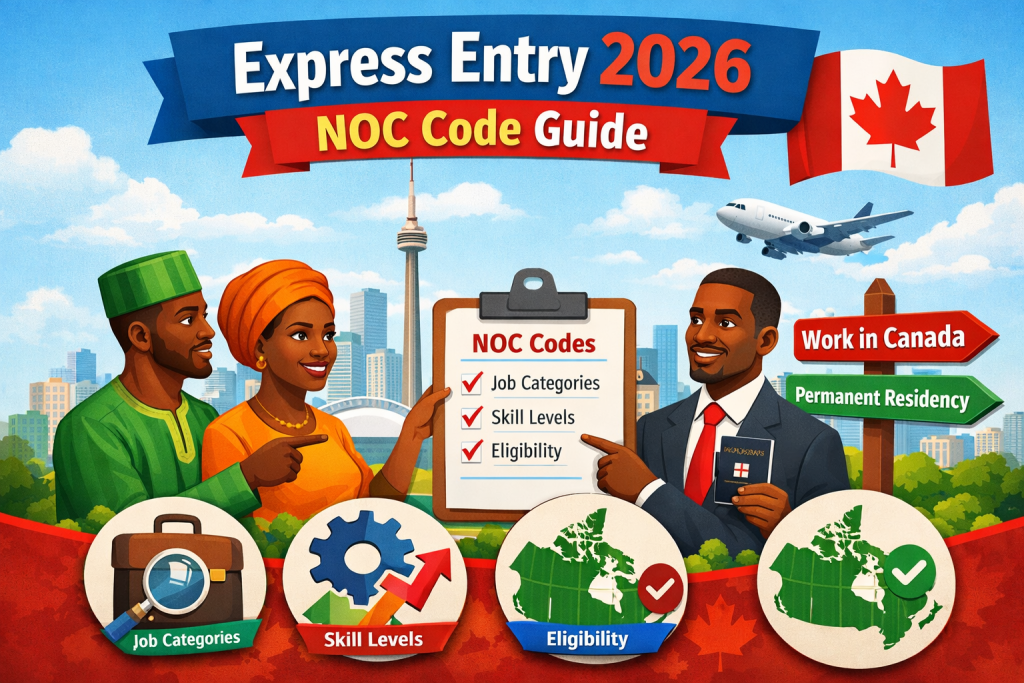
What Express Entry is (and what it is not)
Express Entry is Canada’s online system for managing applications for skilled immigration programs. IRCC runs invitation rounds (“draws”) and selects candidates based on a points system called the Comprehensive Ranking System (CRS) and, in some draws, category criteria.
If you want the official explanation from government, start here:
Express Entry rounds of invitations.
The three programs inside Express Entry (big picture)
Before you even think about categories, you must qualify for at least one program managed under Express Entry. IRCC explains program eligibility here:
Who can apply.
Why this matters: category draws don’t bypass eligibility. Categories filter the pool after you’ve already qualified and entered it.
General draws vs program-specific vs category-based draws
- General draws: IRCC invites top-ranking candidates overall (CRS drives selection).
- Program-specific draws: Invitations limited to a program (for example, Provincial Nominee Program draws).
- Category-based draws: Invitations focused on candidates who meet category criteria (and then ranked).
IRCC’s official category-based overview is here:
Category-based selection.
What IRCC officially lists for 2026
Let’s stick to what IRCC publishes on official pages not what someone screenshotted on WhatsApp.
IRCC’s category-based selection page lists categories used for category-based draws. You can verify the current categories here:
IRCC category-based selection.
Here’s a plain-English summary of what those categories mean and how to react as an applicant:
| IRCC category (as listed) | What it means in plain English | What you should do (practical next step) |
|---|---|---|
| French-language proficiency | Strong French can make you eligible for targeted category draws. | Plan TEF/TCF Canada; keep English strong for CRS. |
| Healthcare and social services | IRCC targets healthcare roles and related services. | Choose the correct NOC; prepare a detailed reference letter. |
| STEM | Science/tech/engineering/math occupations. | Match duties carefully; tech titles overlap a lot. |
| Trade occupations | Skilled trades IRCC wants to attract. | Organize proof of duties, hours, tools, pay, and site records. |
| Education occupations | Teaching and education roles. | Prepare HR letters from schools + proof of employment. |
| Transport occupations | Transport/aviation-related occupations may be targeted. | Be ready for strict verification; add licenses/logs where relevant. |
| Physicians with Canadian work experience | Targets physicians already working in Canada. | If outside Canada, treat as a long-term pathway. |
| Researchers with Canadian work experience | Targets researchers with Canadian experience. | Canadian experience is key; outside Canada it’s not an immediate route. |
| Senior managers with Canadian work experience | Targets senior managers with Canadian work experience. | Strong Canadian work history + strong proof are essential. |
| Skilled military recruits | Targets specific highly skilled military roles. | Not typical for most overseas applicants; verify details if applicable. |
Source:
IRCC category-based selection.
Why there is no single “master occupation list”
This is where many people get confused and where scammers make money.
IRCC publishes category information on category pages, and then publishes draw-by-draw details in the “Rounds of invitations” system. That means your eligibility is often tied to:
- your program eligibility (you’re in the pool),
- the category requirements (French, healthcare, STEM, etc.), and
- the specific draw instructions for that round.
Translation: A category can exist, but the exact invited occupations can vary based on instructions and occupation lists/tables linked to that category and round.
Bookmark these two official pages:
If you like going deeper, IRCC also maintains an official table of ministerial instructions for rounds:
Ministerial instructions: Express Entry rounds.
How category-based selection works (simple explanation)
Here’s the simplest way to understand category-based selection:
The “two-door” reality
- Door 1: You qualify for an Express Entry program and enter the pool.
- Door 2: A draw happens. If it’s category-based, IRCC filters the pool to candidates who meet the category requirements and invites the top-ranked candidates (CRS still matters).
IRCC describes this approach here:
How category-based selection works.
Why CRS still matters even in a category draw
Because categories don’t remove competition they change who you compete with. If 15,000 people meet “healthcare,” IRCC still needs a ranking method. CRS is how they rank.
How to plan around this: treat categories as a spotlight, not a guarantee. Your best strategy is to combine category eligibility with CRS improvement.
If you want to estimate your CRS score using an official tool, use:
Check your score (IRCC).
Step-by-step: How to find your NOC 2021 code (without guessing)
This is the part that saves people from heartbreak.
Your NOC (National Occupational Classification) code is how Canada labels your work experience. The safest approach is to match your real duties to the NOC’s “main duties.” IRCC’s “Find your NOC” guide starts here:
Find your NOC.
The official NOC portal is here:
NOC (ESDC),
and you can use the
advanced search tool.
Step 1: Start with your real duties (not your job title)
Job titles in Nigeria can be broad or “company-specific.” For example:
- Operations Officer could mean logistics, admin, procurement, or customer operations.
- IT Support could mean basic troubleshooting or full systems administration.
- Business Development might be sales, partnerships, or marketing.
Do this: Write 8–12 bullet points describing what you actually do in a normal month. Keep it honest. Keep it specific.
Step 2: Search the NOC portal using 3–5 keyword variations
Search your title, then search the “closest Canadian equivalent.” If your title is uncommon, search by duties keywords. Examples:
- “customer support”
- “network administrator”
- “accounts payable”
- “registered nurse”
Step 3: Open multiple results and compare “main duties”
Don’t settle on the first result. Open 3–5 likely matches, then ask:
- Do the listed duties match most of what I do?
- Can my employer confirm these duties in a reference letter?
- Does the role description match my level (responsibility, tools, seniority)?
Step 4: Check TEER (quick sanity check)
NOC 2021 uses TEER categories based on training, education, experience and responsibilities. IRCC covers TEER and eligibility basics here:
Who can apply.
Why TEER matters: Your NOC code must align with your experience level. If your duties are junior but you choose a code that reads like a senior specialist role (or vice versa), it can trigger credibility problems.
Step 5: Build your “proof file” immediately
This is where many applicants fail not because they aren’t skilled, but because they can’t prove it clearly.
Create one folder named: NOC Evidence Pack. Add:
- Your selected NOC code + title
- A duty-matching sheet (template below)
- Reference letters, payslips, contracts, HR confirmations, bank salary deposits
- Supporting proof like projects, schedules, certifications (when relevant)
Why this matters: When you finally get an ITA, you don’t want to start begging HR for a letter under pressure. You want to upload clean documents calmly.
Step-by-step: How to confirm your NOC is eligible for a 2026 category draw
Step 1: Confirm the category exists on IRCC’s official page
Start here:
IRCC category-based selection.
Step 2: Read the category requirements (don’t rely on summaries)
Category pages can include language thresholds and experience expectations. For example, French proficiency draws will reference language testing. Healthcare and STEM categories may rely on occupation groupings and experience windows. The details that hurt people are usually small, like timing or proof quality.
Why: People lose time because they assume “I’m a nurse, so I’m eligible.” Eligibility often includes timing (recent experience), proof, and sometimes specific occupation groupings.
Step 3: Verify using draw instructions for the specific round
Each draw has details. Use:
Step 4: Match your NOC and your experience window
Even with the right NOC, timing matters. If a category expects recent experience, older work may not count. This is why you should keep your employment letters and pay proof consistent and up to date.
Step 5: Repeat monthly
Don’t treat eligibility as a one-time decision. Categories and priorities evolve. IRCC publishes consultation and policy materials that help you understand the direction of selection. Example:
Consultations and selection priorities report.
Mini walkthrough: How to read a draw page like a pro
This is a practical skill. Once you learn it, you stop relying on rumors.
- Open the official draws page:
Rounds of invitations. - Click the most recent round and look for the round type (general, program-specific, or category-based).
- Check the CRS cut-off (this tells you the competitiveness of that round).
- If it’s category-based: read the category name and the instructions for eligibility. Some rounds include extra conditions beyond simply “I work in STEM.”
- Compare to your profile: Do you actually meet the category rules and can you prove your NOC match with documents?
- Save the link as a reference, but don’t treat one draw as a promise of future draws.
Pro tip: Create a simple spreadsheet or notes file that tracks: draw date, draw type, CRS cut-off, and whether your category appeared. This helps you plan without panic.
Real examples (Nigeria/Africa-focused)
These examples are realistic. They show “how to think,” not “guaranteed outcomes.”
Example 1: Ada (Registered Nurse in Lagos) targeting healthcare
Ada has 4 years of experience. She assumes “nurse = eligible.” That’s common—but she verifies properly.
- She finds the closest NOC: She searches the NOC portal, opens multiple options, and matches duties not just the title.
(NOC portal) - She prepares proof early: employment letter, payslips, bank salary credits, and a detailed reference letter describing clinical duties (assessment, medication administration, care plans, documentation).
- She checks the healthcare category page and then watches the draws page for actual category rounds.
(Category-based selection)
Why this works: If IRCC checks her duties and timeline, her documents tell the same story. No gaps. No vague letters.
Example 2: Tunde (Software Developer in Abuja) targeting STEM
Tunde’s biggest risk is choosing the wrong NOC because tech titles overlap. He does three smart things:
- He documents responsibilities: features built, code reviews, system maintenance, cloud deployments whatever he truly does.
- He matches duties to the NOC: not to what he wants the job to be.
- He keeps evidence: project summaries, internal role descriptions, and a reference letter that describes duties clearly (without copying the NOC text word-for-word).
Hard truth: STEM can be highly competitive. If his CRS isn’t strong, he needs a backup plan like researching PNP routes or improving language scores. (Internal link suggestion: PNP guide)
Example 3: Sani (Aircraft maintenance technician) targeting transport
Transport occupations may be targeted in category-based selection. Sani does the smart thing: he assumes verification will be strict.
- He finds the correct NOC by matching duties (maintenance checks, inspections, compliance logs, safety procedures).
- He adds extra proof: certifications, training records, maintenance logs, and supervisor verification.
- He checks transport category details and waits for draw instructions before assuming eligibility.
Why: Transport roles can attract deeper verification. Better documentation reduces stress later.
Example 4: Chioma (not in a consistently targeted occupation) using French as a strategy
Chioma works in a role that may not be targeted often. Instead of waiting forever, she builds an advantage.
- She plans TEF Canada or TCF Canada.
- She studies steadily (speaking practice matters), then tests and updates her profile.
- She keeps English strong because CRS still matters.
French proficiency details start on IRCC’s category page:
French-language proficiency category.
Common NOC mistakes Nigerians make (and how to fix them)
This section alone can save you months.
Mistake 1: Picking a NOC by job title alone
Why it happens: Titles feel easy. Duties feel complex.
Fix: Match your actual duties to the NOC “main duties.” If most duties don’t match, choose another code.
Mistake 2: Writing vague reference letters
Letters like “He worked diligently and handled tasks assigned” are not helpful.
Fix: Your letter should include: dates, hours/week, pay, location, and specific duties. Use the “Evidence Pack” template near the end.
Mistake 3: Copying NOC duties word-for-word into your reference letter
Why it’s risky: It can look scripted and raise questions.
Fix: Use natural wording that reflects your real work. It should overlap in meaning, not in exact phrasing.
Mistake 4: Not preparing proof until after receiving an ITA
Why it hurts: HR delays, company closures, supervisor travel anything can happen.
Fix: Build your document pack now. If you get an ITA, you submit calmly.
Mistake 5: Paying someone to “create” work history
This can lead to refusal and possible bans for misrepresentation. It’s not worth it.
Fix: Only submit what you can prove. If your situation needs expert help, use authorized support and still verify official requirements.
If your occupation isn’t targeted: realistic options
If your occupation isn’t appearing in category draws, you still have options. The right option depends on your budget, timeline, and profile strength.
Option 1: Improve CRS (the boring but powerful path)
CRS improvements often come from:
- Better language scores (English and/or French)
- Education recognition (ECA where required)
- Additional work experience
- Spouse factors (if applicable)
Use the official CRS tool:
Check your score.
Option 2: Provincial Nominee Programs (PNPs)
PNPs can be a strong plan B (or even plan A) depending on your occupation and province demand. Always verify on official provincial government websites.
Internal link suggestion: Provincial Nominee Program guide
Option 3: Study in Canada (only if it makes financial sense)
Studying in Canada can be a real pathway for some people, but it’s expensive and not automatic. If you go this route, verify schools properly.
Internal link suggestion: DLI checklist for Nigerians
Costs, timelines, and hard truths (avoid scams)
Reality check you should accept early
- Draw cut-offs change.
- Being eligible doesn’t guarantee an invitation.
- Documentation quality can be the difference between approval and refusal.
Budgeting: common items people pay for (costs vary)
Typical costs include language tests, educational credential assessments, police certificates, medical exams, and document translations. Always verify current fees and procedures on official provider sites.
| Item | Why you need it | Official link |
|---|---|---|
| English language test (IELTS or CELPIP) | Language results affect eligibility and CRS points. | IELTS | CELPIP |
| French test (TEF or TCF Canada) | Helps with French category eligibility and CRS. | TEF |
| Educational Credential Assessment (ECA) | Helps IRCC recognize foreign education credentials. | WES Canada |
| School verification (DLI list) | Required if you pursue study permits. | DLI list |
Red flags (please don’t ignore these)
- “Guaranteed ITA in 2 weeks.”
- “We’ll create a job letter for you.”
- “You don’t need proof of duties.”
Internal link suggestion: How to avoid immigration scams
Final checklist: your 2026 readiness plan
- Confirm IRCC’s current categories:
Category-based selection - Find your NOC and verify duties:
Find your NOC
and
NOC portal - Create your evidence pack (template below) and keep it updated.
- Prepare language tests (English + French if strategic).
- Monitor draw instructions monthly:
Rounds of invitations
FAQs
Do category-based draws guarantee an ITA?
No. Category-based draws invite top-ranked candidates who meet the category criteria. You still compete on CRS within that category. Use official draw pages to verify cut-offs and criteria:
Rounds of invitations.
Can IRCC change categories during the year?
Categories and selection priorities can be reviewed over time. Always verify the current categories and draw instructions on official IRCC pages.
What if my job title is different from the NOC title?
That’s normal. Your duties matter more than your title. Match your real work to the NOC “main duties,” and ensure your reference letter supports it.
Do I need a job offer?
Not always. Many Express Entry candidates are invited without a job offer. Some provincial routes may involve employer support, so verify requirements by pathway.
How often do draws happen?
Draw frequency can change. The safest approach is to monitor IRCC’s official rounds page and track trends over time:
Rounds of invitations.
Two ready-to-use deliverables (templates)
These are designed so you can copy them into a document, fill them, and keep them as your “ready-to-submit” package.
Deliverable 1: One-page NOC Evidence Pack Template (reference letter checklist + duties matching sheet)
| Candidate name | ________________________________ | Email/Phone | ________________________________ |
| NOC 2021 code | ________________________________ | NOC title | ________________________________ |
| TEER | ________________________________ | Employer | ________________________________ |
Reference letter checklist (tick when included)
- Company letterhead + address + contact details
- Your full legal name and job title
- Exact employment dates (start/end)
- Hours per week (exact) + full-time/part-time
- Salary and benefits
- Detailed duties (specific, not vague)
- Supervisor/HR name, title, signature, date
Supporting documents (strong proof)
- Contract/offer letter
- Payslips (3–6+ months)
- Bank statements showing salary deposits
- Tax documents (where available)
- Promotion/appraisal letters
- Work samples/projects (sanitized if needed)
Duties matching sheet (the most important page)
| NOC main duty (from NOC page) | Your real duty | Evidence (choose) |
|---|---|---|
| 1) __________________________ | __________________________ | Letter / Payslip / Project / Other |
| 2) __________________________ | __________________________ | Letter / Payslip / Project / Other |
| 3) __________________________ | __________________________ | Letter / Payslip / Project / Other |
| 4) __________________________ | __________________________ | Letter / Payslip / Project / Other |
| 5) __________________________ | __________________________ | Letter / Payslip / Project / Other |
Quick check: If you can’t honestly match most duties, choose a different NOC before you submit anything.
Deliverable 2: Category-by-category action plan (tailored to a Nigerian applicant profile)
Typical profiles covered: (A) Age 23–29, Bachelor’s, 2–5 years experience. (B) Age 30–39, Bachelor’s/Master’s, 5–10+ years experience.
| Category | Best for | Your 30–90 day plan | Hard truth |
|---|---|---|---|
| French-language proficiency | Applicants who can build strong French (or already have it) | Pick TEF/TCF; study daily; test; update profile; keep English strong | French takes time no shortcuts, but it can be a powerful differentiator |
| Healthcare & social services | Nurses, clinical roles with clean proof | Pick correct NOC; secure detailed reference letter; organize payslips/bank proofs; monitor draw instructions | Targeted doesn’t mean automatic documentation quality matters a lot |
| STEM | Software/IT/engineering roles | Choose NOC carefully; document tools/projects; strengthen reference letter; keep PNP as backup | Competition can be intense; CRS improvements may be necessary |
| Trades | Skilled trades with strong evidence | Collect contracts, pays, site records; ensure duties and hours are provable | Trades evidence can be messy organization is everything |
| Education | Teachers and education professionals | HR letters + payslips; match NOC duties; verify school legitimacy if private | Some roles are provincially regulated for licensing later |
| Transport | Aviation and other transport roles | Get duty-aligned NOC; add licenses/logs; expect stricter checks | Eligibility can depend heavily on draw instructions and occupation group |
| Canadian work experience categories | Mostly candidates already working in Canada | If outside Canada, treat as long-term plan; focus on other categories first | Without Canadian experience, these categories usually won’t apply |
Next steps: Choose your best-fit strategy (category + CRS plan), then build your evidence pack so you’re not scrambling after an invitation.
Author bio
About the author: This guide was researched and written by an editorial team focused on practical immigration and education information for Nigerians and Africans. Our process prioritizes official Government of Canada sources (IRCC and ESDC/NOC), cross-checking draw mechanics and eligibility rules, and translating them into step-by-step actions readers can follow.
Internal links used in this article:
PNP guide,
DLI checklist,
Avoid immigration scams.
Primary official references (DoFollow outbound links):


 Chiprince
 Lucky Okezie