 Chiprince
If you’ve been searching for the difference between scholarships, grants, and bursaries and you’re reading from Nigeria (or anywhere in Africa), you’re in the right place.
Let’s be honest: education funding talk online can feel like pure noise. One person says “apply for scholarships,” another says “look for grants,” someone else says “your state gives bursaries,” and before you know it, you’re confused and wasting time on applications you were never eligible for in the first place.
This guide is for the person in Benin City, Lagos, Abuja, Enugu, Port Harcourt, Ibadan, Kano anywhere who wants a clear explanation without hype. Maybe you’re trying to pay for UNIBEN or UNILAG today. Or you’re planning a Master’s in the UK, Canada, Germany, Australia, or Europe tomorrow. Either way, these labels matter because they affect who qualifies, what the money covers, and how you apply.
I’ll explain everything like I’m talking to a friend: simple, practical, and realistic plus official links so you can verify things yourself and avoid “funding gist” that isn’t true.
What you’ll learn
- The practical meaning of scholarships, grants, and bursaries (without jargon)
- Why each one exists and who typically funds it
- How to quickly tell which option fits your situation (merit vs need vs specific groups)
- When to apply and how to plan your year around deadlines
- A step-by-step plan to find, filter, and apply from Nigeria
- Common mistakes Nigerians make and how to avoid them
- Country/category breakdown (Nigeria, UK, Canada, Europe/Erasmus, Germany/DAAD, Australia Awards)
- Smart money planning: proof of funds, education loans, insurance, and international transfers (the clean way)
Disclaimer: This article is educational and based on official sources and reputable institutions. However, requirements may change (eligibility, amounts, deadlines, and rules can shift yearly). Always confirm details on the official programme, university, or government website before applying.
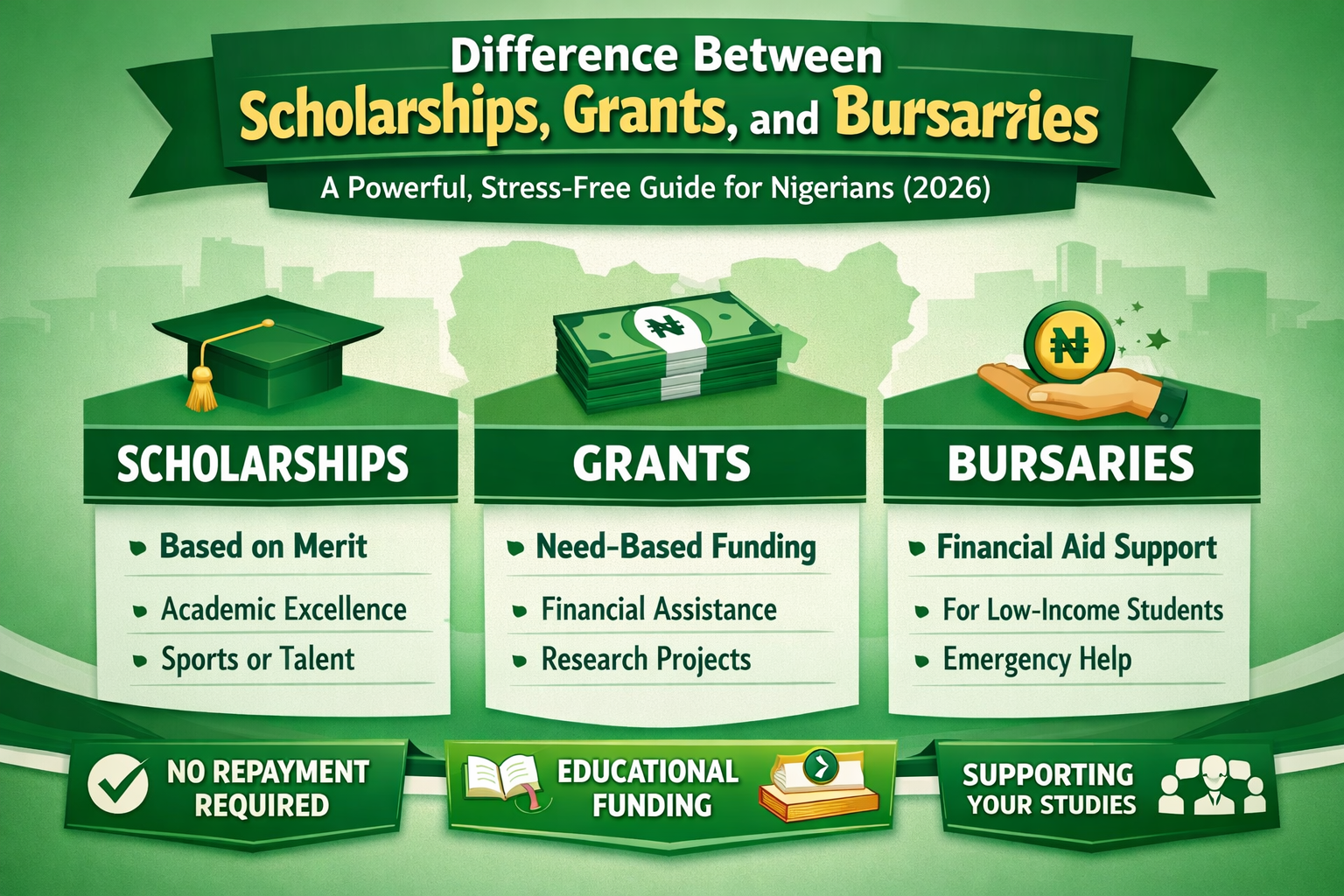
Difference Between Scholarships, Grants, and Bursaries (the simple explanation in 60 seconds)
Think of scholarships, grants, and bursaries as “education support money you usually don’t repay,” but each one has a different main purpose.
Scholarships: usually merit-based (sometimes profile-based)
A scholarship commonly rewards something about you: strong grades, leadership, talent, or a specific profile (for example, applicants from certain countries, communities, or fields).
UCAS (a major UK admissions platform) explains that scholarships can be linked to achievements, background, or course choice and can support study costs.
UCAS scholarships/grants/bursaries overview.
A well-known example is the UK government’s Chevening programme for one-year Master’s degrees.
Chevening Scholarships.
Grants: often need-based (and tied to a policy goal)
A grant is often about need. Many governments use grants to make education more accessible for people who cannot reasonably afford it.
Canada’s student aid pages explain the difference clearly: grants generally don’t need to be paid back (unlike loans).
Canada: student grants and loans.
Bursaries: usually to remove practical barriers
Bursaries typically exist to stop practical costs from blocking a student: transport, books, equipment, accommodation deposits, and basic living support.
The UK’s 16–19 Bursary Fund guidance describes bursary support as a way to help students overcome financial barriers to participation.
UK 16–19 Bursary Fund guide (2025–2026).
The hard truth about the labels
Different schools and countries sometimes use these words differently. One university might call everything “scholarship” even when it behaves like a bursary. So don’t trust the label alone.
Always check: (1) eligibility, (2) what it covers, (3) whether it’s repayable (usually not), and (4) conditions (CGPA rules, attendance rules, return requirements, etc.).
Table 1: Scholarships vs grants vs bursaries (quick comparison)
| Feature | Scholarship | Grant | Bursary |
|---|---|---|---|
| Main idea | Reward merit/talent/leadership (sometimes profile-based) | Support need or a government/education policy goal | Remove financial barriers so students can participate |
| Typical funders | Universities, donors, governments, foundations | Governments, institutions, charities | Schools/colleges, governments, providers |
| Selection style | Often competitive | Often assessed through an aid application | Often assessed by need + circumstance |
| What it may cover | Tuition, living costs, travel (varies) | Tuition/living support (varies) | Books, transport, fees, living support (varies) |
| Repayment | Usually no | Usually no | Usually no |
| Example sources | Chevening (UK) | Canada grants/loans | UK bursary guide |
Why these funding types exist (this is how you stop applying blindly)
Why scholarships exist
Scholarships are often used to attract strong students, reward excellence, and support people who show leadership or talent. They also help universities and governments invest in fields they consider important (like healthcare, engineering, education, tech, climate, policy).
Chevening is a good example of a leadership-focused scholarship supported by the UK government.
Chevening programme overview.
Why grants exist
Grants exist because governments (and some institutions) believe education should remain accessible even when money is tight. The goal is to reduce the barrier for people who qualify on need or circumstances.
Canada’s system is a clean example: grants are typically non-repayable, while loans are repayable.
Canada student aid: grants vs loans.
Why bursaries exist
Bursaries exist because many students don’t fail because they’re not smart. They fail because of small but heavy costs: transport every day, books, lab materials, rent deposits, feeding, or the stress of constantly borrowing.
The UK bursary guidance frames bursaries as support to overcome financial barriers to participation.
UK bursary guidance.
Hard truths Nigerians should hear early (so you don’t lose money and time)
- Not everyone qualifies for everything. Funding is targeted. The more famous the award, the more competitive it is.
- “Fully funded” posts online can be outdated or fake. If it’s not on an official website, don’t treat it as fact.
- Partial funding is common. Many offers cover tuition but not living costs, or cover part of tuition only.
- Even when you win, you’ll still have expenses. Visa fees, transcript courier, tests, medicals, deposits, flights, exchange-rate shocks.
- Proof of funds is real. If you’re applying abroad, your funding story must be clean and verifiable no shortcuts.
Step-by-step guide: How to choose the right funding and apply from Nigeria
Step 1: Decide what you’re trying to fund (be specific)
Before you open ten tabs, answer these questions like you’re writing a plan:
- Do I need help with tuition, living costs, or both?
- Is this for Nigeria or study abroad?
- What level am I applying for: UG, Master’s, PhD, short course?
- What is my strongest angle: merit, need, background, or field?
Real-life examples (Nigeria):
- Chidinma (Lagos): 2:1, strong volunteering record, 2 years work experience. Her best approach is merit/leadership scholarships + strong university awards. If she gets partial funding, she plans the remainder with savings and a realistic budget.
- Bala (Kaduna): strong grades but low household income. His best approach is bursaries/need-based support and schools known for financial aid. He prioritizes getting documents early because delays can kill deadlines.
- Amaka (Benin City): decent grades, great community leadership, and a clear plan to work in healthcare. She targets scholarships that value leadership and service, not only “perfect grades.”
Step 2: Build a shortlist of 10 – 20 “real” opportunities
Not 100. Not “anything I see on social media.” A shortlist you can actually complete without burning out.
Start from verified sources:
- Nigeria Federal Ministry of Education scholarship portal
- Federal Scholarships overview (Nigeria)
- Chevening (UK)
- Chevening eligibility criteria
- Chevening: what it covers
- Canada student aid overview
- Erasmus Mundus Joint Masters
- DAAD scholarships overview
- Australia Awards Africa: how to apply
Helpful internal reads (to move from “reading” to “doing”):
- How to Apply to Foreign Universities from Nigeria (2026 guide)
- Admission Requirements for Nigerian Students Studying Abroad
- Fully Funded Scholarships Nigerians Can Apply for in 2026
Step 3: Classify each opportunity before you apply (your quick “fit check”)
For each opportunity, write down:
- Is it merit-based, need-based, or targeted (based on what the official page says)?
- What level is it for (UG/Master’s/PhD)?
- What does it cover (tuition only, living only, both, travel, visa, insurance)?
- Who can apply (citizenship limits, course limits, work experience requirements)?
- Deadline window (month and year)
- Required documents
If you can’t clearly answer those from the official page, pause. Don’t rush into application mode yet go back and verify.
Step 4: Prepare your core documents once (and reuse them smartly)
Most legitimate applications ask for similar documents. If you prepare them early, you reduce stress and avoid mistakes:
- Transcripts and certificates
- CV (clean, 1–2 pages)
- Personal statement/statement of purpose
- Two references (lecturers, employers, supervisors)
- International passport (for travel-based programmes)
- English test results (when required)
- Research proposal (often for PhD/research)
Nigeria reality check: transcript delays can quietly destroy your plan. If your school takes weeks or months, treat transcripts like an emergency. Start early, follow up politely, and keep proof of request.
Step 5: Apply in the right order (this is where many people get stuck)
A common safe order is:
- Pick course + university (or programme)
- Apply for admission (when required)
- Use your offer letter to strengthen scholarship/bursary applications (when applicable)
- Secure funding + plan deposits
- Visa steps + proof of funds + insurance
But always follow the programme’s instructions. Some awards want you to apply first; others want an admission offer first. Don’t assume.
Step 6: Budget “hidden costs” early (the money you don’t see in headlines)
Even if you win funding, you may still pay for:
- passport renewal
- transcripts and courier
- test fees (IELTS/TOEFL/PTE/GRE, depending)
- visa fee and biometrics
- medical exam (country-dependent)
- flight or deposit
- health/travel/student insurance
Erasmus Mundus scholarships, for example, can contribute to participation costs and support items like travel and living allowance (details vary by programme).
Erasmus Mundus overview.
A practical tip: create a “funding folder” and keep every receipt (tests, transcript payments, courier, deposits). If someone later asks how you funded something, you won’t be guessing.
Step 7: Plan a clean funding mix (most people need a combination)
It’s normal to combine funding where rules allow:
- partial scholarship + savings
- partial scholarship + education loan
- bursary/grant + family support
If you’re considering loans in Nigeria, verify terms and eligibility through official channels. Nigeria’s student loan initiative is available via NELFUND:
NELFUND portal.
Also, if you’re receiving money from abroad (stipends, family support), plan your banking and transfers properly. Use reputable providers, keep records, and avoid “cash-only” arrangements that can’t be explained later.
Step 8: Track your applications like a project (simple tracker beats motivation)
Use Notes, Google Sheets, or Excel. Track:
- Opportunity name + link
- Deadline
- Documents needed
- Status (not started/in progress/submitted)
- Outcome
This is how serious applicants win: not by applying to everything, but by applying well.
Table 2: Documents checklist and timeline (Nigeria-friendly)
| Stage | What you need | Why it matters | When to start |
|---|---|---|---|
| Identity | International passport (for abroad), consistent names on documents | Name mismatches can delay applications and verification | 6–12 months before deadlines |
| Academics | Transcripts, certificates, class rank (if available) | Most funding decisions start with academic proof | 6–9 months before deadlines (earlier if transcripts are slow) |
| Language | IELTS/TOEFL/PTE results (if required) | Some universities and scholarships require this; waivers vary | 6–10 months before deadlines |
| Story + fit | Personal statement, course plan, CV | This is how you stand out beyond grades | 4–8 months before deadlines |
| References | 2 referees who will respond on time | Late references can kill a strong application | 3–6 months before deadlines |
| Money planning | Budget, proof of funds plan, loan plan (if needed), transfer records | Prevents last-minute panic and risky decisions | 3–6 months before deadlines |
How to verify a scholarship/grant/bursary is legit (so you don’t get scammed)
This section is important because scams don’t always look like scams. Some are polished. Some even use real logos. The safest approach is boring but effective: verify using official sources.
Legitimacy checklist (quick and practical)
- Start from official domains: government sites (.gov.uk, canada.ca, education.gov.ng) or well-known programme sites (chevening.org, daad.de, Erasmus+).
- Look for an application process that makes sense: real programmes explain eligibility, required documents, deadlines, and how selection works.
- Be cautious with “payment to apply”: many legitimate scholarships are free to apply. Some universities charge application fees, but a “scholarship agent fee” is a red flag.
- Check contact details: real organisations list official email addresses and pages, not only WhatsApp numbers.
- Search the programme on its own official site: don’t rely on screenshots or forwarded posts.
- Protect your identity: don’t send passport biodata or bank statements to random contacts. Use official portals.
If you want a deeper “mistakes to avoid” guide, this internal article is useful:
Common Mistakes Nigerians Make When Applying to Study Abroad.
Common mistakes (and how to avoid them)
Mistake 1: Using random blogs as your main source
Fix: start from official portals and official university pages. Use blogs only as “direction,” not proof.
Mistake 2: Confusing “tuition scholarship” with “fully funded”
Fix: read what it covers. Some awards pay tuition only; living costs still remain. Chevening explains coverage on its FAQ page:
Chevening: what it covers.
Mistake 3: Writing a personal statement that sounds like begging
If your statement is basically “I need money,” you’ll likely lose. Funding bodies want clarity: goals, proof, and fit.
Better approach:
- Explain what you want to study and why
- Show evidence (projects, leadership, work experience)
- Explain why that course and that school/programme makes sense
- Show your plan for impact (career, community, research, policy)
Mistake 4: Ignoring eligibility details until the last minute
Fix: treat eligibility rules like a checklist. Chevening’s eligibility page is a good example of specific official criteria:
Chevening eligibility.
Mistake 5: Paying someone to “guarantee” a scholarship or visa
Hard truth: there are scams. Legit programmes don’t need you to pay someone to “secure” a slot. Apply through official channels and protect your money.
Country/category breakdown (Nigeria, UK, Canada, Europe, Germany, Australia)
Nigeria: where to start
PTDF (sector-focused support)
If you’re looking at PTDF, use their published guidelines and follow instructions strictly:
PTDF scholarship guidelines.
UK: scholarships, grants, and bursaries
Example university funding page (UK):
University of Manchester: funding and scholarships.
Canada: understanding grants vs loans
Scholarship resources for international contexts:
EduCanada scholarships.
Example university scholarships page (Canada):
University of Toronto: scholarships for international students.
Europe: Erasmus Mundus
Erasmus Mundus Joint Masters is a major route many Nigerians aim for because it can support major study costs.
Erasmus Mundus Joint Masters.
Germany: DAAD
DAAD is one of the most recognized scholarship providers connected to study and research in Germany.
DAAD scholarships overview.
Australia: Australia Awards
Australia Awards Africa provides guidance on how to apply:
Australia Awards Africa: apply.
Australia’s DFAT also publishes opening/closing dates:
DFAT: Australia Awards dates.
Table 3: Which one should you focus on (based on your situation)?
| Your situation | Best fit | Why it makes sense | What to do this week |
|---|---|---|---|
| Strong CGPA + leadership + clear goals | Scholarship | Merit and leadership are rewarded | Draft your statement + ask referees early |
| Low household income + good academic standing | Grant/Bursary | Need-based support is designed for financial barriers | Gather proof of need + confirm eligibility criteria |
| You’re in a target group (e.g., education track, disability, vulnerable background) | Bursary + some grants | Many bursaries focus on widening access | Check school/state options + ask your department |
| Partial tuition award but living costs are the problem | Mixed plan | Funding often comes as a package | Budget living costs + plan a clean funding mix |
| You want major international programmes | Chevening / Erasmus / DAAD / Australia Awards | They can cover large costs but are competitive | Shortlist 3–5 programmes + study eligibility closely |
Mini glossary (so funding pages don’t confuse you)
- Tuition waiver: tuition is reduced or removed; living costs may still remain.
- Stipend: regular payment for living expenses.
- Deposit: upfront payment to secure a place (common with admissions).
- Conditional offer: you’re accepted if you meet conditions (final transcript, IELTS score, etc.).
- Cost of attendance (CoA): total expected cost (tuition + living + other fees).
FAQ (AEO-friendly: short answers)
What is the difference between scholarships, grants, and bursaries?
Scholarships usually reward merit or talent, grants often support financial need or policy goals, and bursaries typically remove practical barriers like transport, books, or accommodation costs.
Do I have to pay them back?
Usually no. But always read the terms because some awards have requirements (minimum grades, attendance, or other conditions).
Can I apply for more than one at the same time?
Often yes, but you may need to declare other funding. Some programmes reduce their amount if you receive another award.
Which one is easiest for Nigerians?
There isn’t one “easy” option. Need-based bursaries can be more reachable if you qualify, while major global scholarships are highly competitive.
Are education loans the same as scholarships or grants?
No. Loans are repayable. Scholarships/grants/bursaries are usually non-repayable. If you’re considering loans in Nigeria, verify details through the official NELFUND portal:
portal.nelf.gov.ng.
How do I avoid scams?
Verify everything on official websites and avoid anyone asking you to pay for a “guaranteed” scholarship, visa, or placement.
Final advice (realistic and trust-building)
If you take only one message from this guide, let it be this: funding is not luck funding is process.
- Get clear on what you need (tuition, living costs, or both).
- Shortlist 10–20 legitimate opportunities using official sources.
- Prepare your documents early (especially transcripts and references).
- Apply consistently and track everything.
- Build a clean, verifiable funding story (savings, transparent sponsorship, education loans if needed, proper insurance, proper transfers).
- Remember: requirements may change, so always check the official page before you submit.
If you want your next step to be simple, focus on admissions + documents first, then connect the plan to funding. These internal guides will help:
- How to Apply to Foreign Universities from Nigeria
- Admission Requirements for Nigerian Students Studying Abroad
- Fully Funded Scholarships Nigerians Can Apply for in 2026
Author Bio
Author: Travel & Tour Research Desk
This guide was compiled using official government portals and recognized scholarship programmes (UK, Canada, EU, Germany, Australia, and Nigeria). The team focuses on practical, Nigeria-friendly study and travel education cross-checking key claims with official sources and updating articles when requirements change.


 Chiprince



 Lucky Okezie

