 Chiprince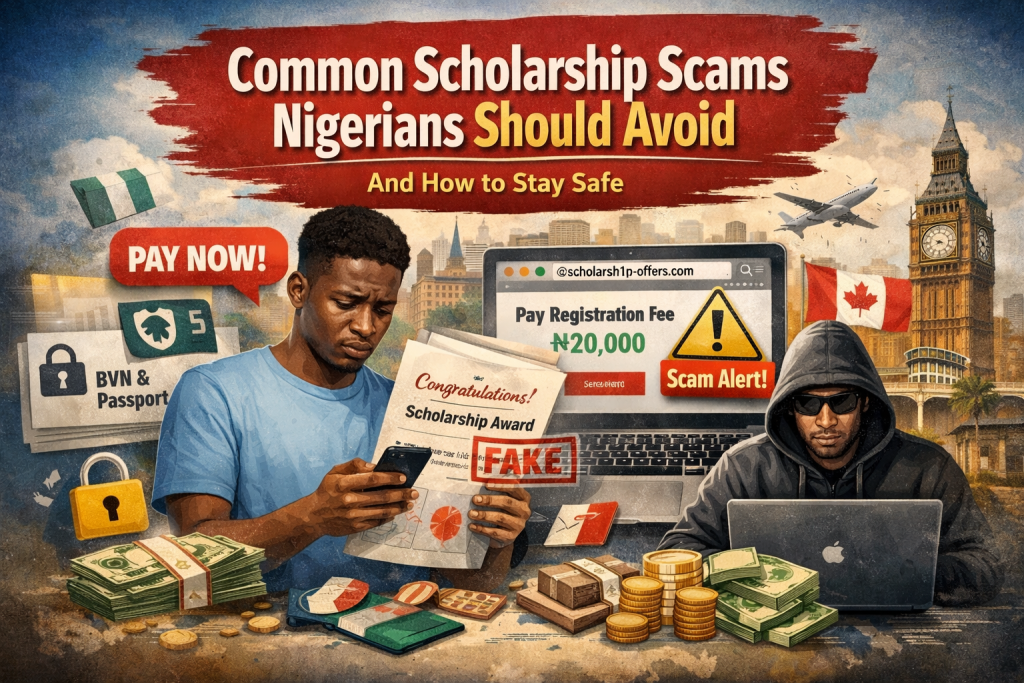
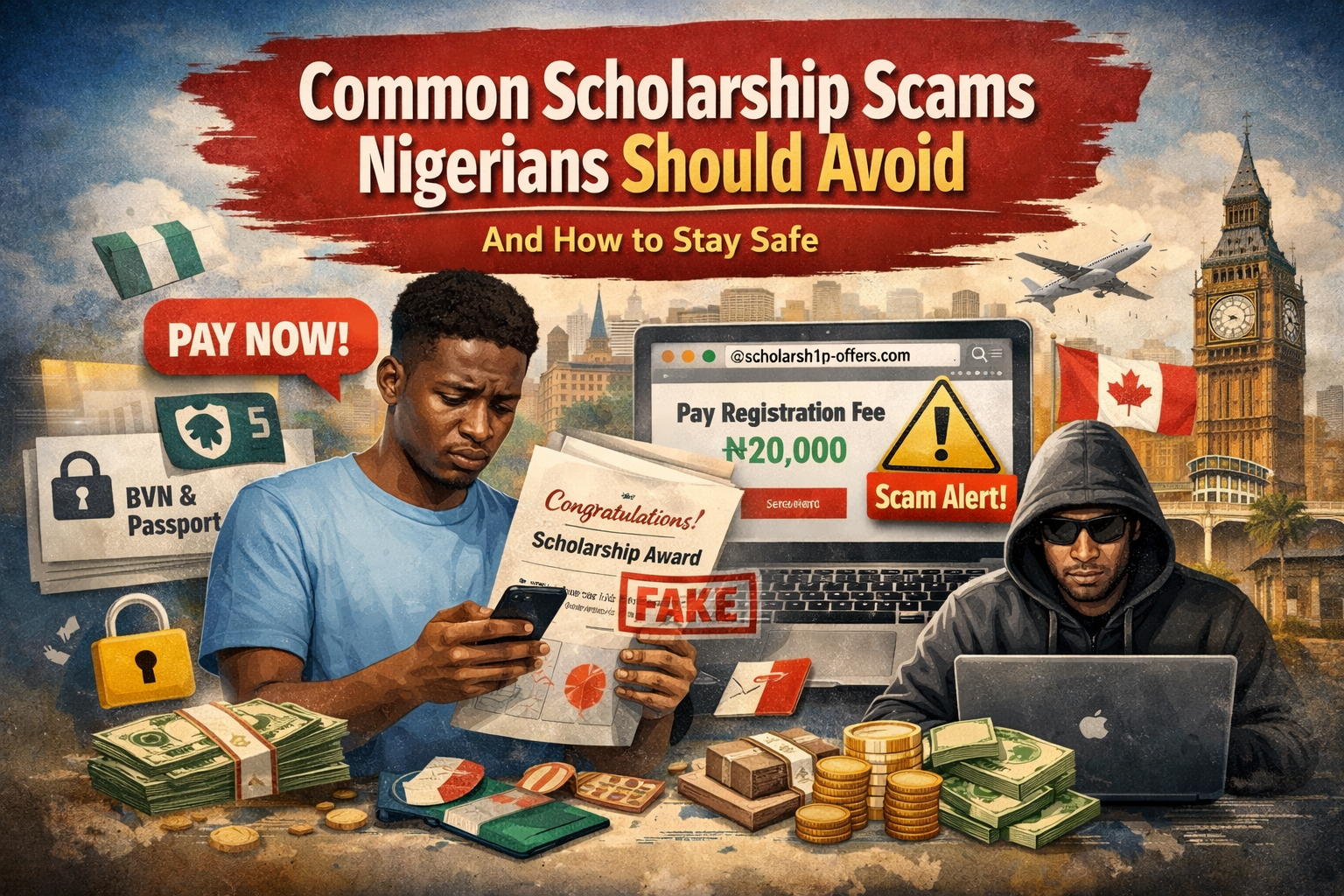
Common Scholarship Scams Nigerians Should Avoid is not just a “nice-to-know” topic. If you’re in Benin City, Umuahia, Lagos, Abuja, Port Harcourt, Enugu anywhere in Nigeria there’s a high chance you’ve already seen a WhatsApp broadcast, a Facebook/Instagram ad, or a “kindly pay registration fee” message claiming you’ve been selected for a fully funded scholarship.
It always hits the same emotional button: hope.
Education really can change your life better jobs in tech, engineering, healthcare, finance, consulting, better networks, and sometimes a clean restart. Scammers know that. So they build traps that look like opportunities and drain people’s hard-earned naira. Sometimes it gets worse: a scammer pushes someone into fake documents, then the person gets visa refusal and a damaged record.
This guide is me talking to you plainly like we’re gist-ing over food so you can chase real opportunities without getting burned.
What you’ll learn
- The most common scam patterns targeting Nigerians (and why they work)
- How scammers operate: fake emails, cloned websites, pressure tactics, “agents”
- A simple step-by-step process to verify any scholarship before you pay or share documents
- Common mistakes Nigerians make and how to avoid them
- Country/program breakdowns: UK (Chevening), Germany (DAAD), EU (Erasmus), Canada, Australia, US
- Two practical tables you can use as a checklist and comparison tool
- Short FAQ answers you can act on immediately
- Final advice that is realistic, not hype
Important Disclaimer (Please Read)
This is an educational guide based on common scam patterns and official fraud warnings. It’s not legal advice. Scholarship rules, application steps, and visa requirements requirements may change. Always confirm details on official websites (government portals, embassies/high commissions, universities, and scholarship program sites) before acting. If you suspect a crime, report through the proper channels.
Helpful official starting points (bookmark these)
- Nigeria Federal Ministry of Education scholarship portal: https://scholarship.education.gov.ng/
- ICPC (petitions/reporting): https://icpc.gov.ng/
- Chevening (official): https://www.chevening.org/
- DAAD (official): https://www.daad.de/en/
- Erasmus Mundus / EU scholarship guidance (scams & warnings): https://www.eacea.ec.europa.eu/scholarships_en
- Canada IRCC scam guidance (email/phone scams): https://ircc.canada.ca/english/helpcentre/answer.asp?qnum=1205
- Australia Home Affairs visa scam guidance: https://immi.homeaffairs.gov.au/help-support/visa-scams
- U.S. Mission Nigeria scam warning: https://ng.usembassy.gov/u-s-mission-to-nigeria-warns-nigerians-about-scammers/
- FTC tips on scholarship/financial aid scams: https://consumer.ftc.gov/articles/how-avoid-scholarship-and-financial-aid-scams
Why scholarship scams thrive in Nigeria (the honest “why”)
Let’s not pretend: scams thrive because pressure is high.
- Many families are juggling school fees, rent, bills, and inflation.
- “Japa” plans are everywhere, so the demand for scholarships is intense.
- People see others traveling and assume “there must be a shortcut.”
- Scam networks are now organized: they run ads, clone websites, and use scripts that sound professional.
And here’s the painful part: scammers don’t need to trick everybody. If they scam 50 people out of ₦10,000 each, that’s ₦500,000. If it’s ₦50,000 each, you already know the story.
They also know when Nigerians are most active:
- When major scholarship windows open (varies by program)
- When students finish NYSC or graduation
- When visa/school admission seasons peak
So the goal is not “avoid scholarships.” The goal is: avoid fake pathways.
Related reading on Travel & Tour: If you’re planning your study abroad journey, these guides help you stay organized (and less scam-prone):
How to Apply to Foreign Universities from Nigeria (2026 Guide),
Common Mistakes Nigerians Make When Applying to Study Abroad,
and Fully Funded Scholarships Nigerians Can Apply for in 2026.
The hard truths Nigerians need to hear
- No legit scholarship is “guaranteed.” Scholarships are competitive. Even if you’re brilliant, nobody can promise you a win.
- There is no “special slot” you can buy. If someone says “Pay and we’ll secure your place,” you’re being sold a lie.
- “Small money” is still money. Scammers love “just ₦5k” or “just ₦10k.” Once you pay once, they escalate: verification fee, interview fee, portal access fee, courier fee, “release fee,” insurance fee, and so on.
- Fake documents can destroy your future. If a scam pushes you into forged bank statements or fake admission letters, you can end up with visa refusal and a damaged record. Don’t let desperation ruin your credibility.
The common scholarship scams Nigerians should avoid
1) “Pay a registration/application/processing fee to secure the form”
This is the most common pattern on WhatsApp and Facebook.
How it looks
- “Chevening form is out – pay ₦15,000 for registration.”
- “Erasmus scholarship registration – pay ₦25,000 to get shortlisted.”
- “DAAD partner fee – pay ₦30,000 for document review.”
Why it’s suspicious
EU scholarship bodies warn applicants to be cautious of scams and fraud around scholarship offers and fee claims. Start here:
https://www.eacea.ec.europa.eu/scholarships_en.
What to do instead
Always apply through the official portals:
- Chevening apply page: https://www.chevening.org/apply/
- DAAD scholarships overview: https://www.daad.de/en/studying-in-germany/scholarships/
- Erasmus Mundus info: https://erasmus-plus.ec.europa.eu/opportunities/opportunities-for-individuals/students/erasmus-mundus-joint-masters
2) Fake “Erasmus/EU scholarship” ads asking Nigerians to pay
“Erasmus” sounds powerful, so scammers abuse the name.
How it looks
- “Erasmus scholarship to study in Canada/Europe. Pay registration fee now.”
Reality check
There have been official fraud alerts about false Erasmus-related scholarship messages that push people to pay “registration fees.” One example:
https://www.eeas.europa.eu/delegations/canada/fraud-alert-beware-erasmus-plus-scam_und_it.
What to do
Use EU official pages only. If payment is involved for anything legitimate (visa fees, medicals, translations), pay only through official channels not to individuals or random “admins.”
3) EducationUSA / U.S. Government “placement” impersonation
This scam targets Nigerians dreaming of top US schools.
How it looks
- “We are EducationUSA. Pay ₦50,000 and we’ll place you in a US university with scholarship.”
Why it’s dangerous
Official warnings have been issued about scammers targeting Nigerians using trusted education branding. Start here:
https://ng.usembassy.gov/u-s-mission-to-nigeria-warns-nigerians-about-scammers/.
What to do
Never pay anyone to “place you.” Apply through official university portals and verified advising networks.
4) Cloned scholarship websites (the “almost identical” trap)
This is how smart people get caught. The site looks real, the logo is correct, the page layout is clean then the payment or document upload is where the damage happens.
Common red flags
- Domain name is slightly off (extra hyphen, misspelling, weird extension)
- No real address or contact page
- Payment goes to a personal account
- They don’t have official email domains
What to do
Type the official website yourself (don’t click random links). Then cross-check from trusted sources (government/university pages linking out).
5) “Agent guarantee” scams (with fake testimonials)
This one is common in Nigeria because it feels “normal” to use an agent for everything. But scholarships don’t work like land purchase.
How it looks
- “Pay ₦120,000. We guarantee shortlist / visa / scholarship.”
Why it works:
It sells certainty in an uncertain process. It also uses pressure: “Pay today or lose your slot.” Consumer protection guidance warns about paying for “guaranteed” money and pressure tactics. See:
https://consumer.ftc.gov/articles/how-avoid-scholarship-and-financial-aid-scams.
What to do:
You can pay for legitimate help (IELTS coaching, editing, document translation). But don’t pay anyone claiming they can sell selection decisions.
6) “Congratulations, you’ve been selected” when you never applied
Simple rule: if you never applied, you were not selected. Don’t pay “verification fees.” Don’t send documents. Block and move on.
7) Document-harvesting disguised as scholarships
Sometimes they want your identity first, money later.
They may request”
- BVN/NIN
- Passport biodata page
- Signature and passport photo
- Bank details or “loan forms”
Why it’s risky”
Identity theft can turn into financial fraud. Only upload sensitive documents inside a verified official portal.
8) “Courier/medical/insurance fee” paid to a personal account
Yes real processes can involve travel insurance/student insurance, police certificates, medical tests, translations. But scammers twist it into “pay me first.”
Red flags”
- “Pay insurance to my Opay/Palmpay.”
- “Pay courier fee to release your award letter.”
- “Pay to fast-track embassy approval.”
What to do
Use official scam guidance when in doubt:
- Australia Home Affairs: https://immi.homeaffairs.gov.au/help-support/visa-scams
- Canada IRCC scam guidance: https://ircc.canada.ca/english/helpcentre/answer.asp?qnum=1205
Step-by-step: How to verify a scholarship (Nigeria-friendly, realistic)
This is the part you can actually follow. Save it. Screenshot it. Use it every time you see a scholarship advert.
- Step 1: Pause and ask “Who owns this scholarship?”
Is it a government program, a university program, or an official international program? If you can’t clearly answer who owns it, that’s a warning sign.Quick example (Benin City)
David sees “African Excellence Fund Scholarship” on WhatsApp. No clear organization, no physical address, no official website just “DM admin.” He searches the name and can’t find it on government or university sites. He walks away and saves his money. - Step 2: Confirm it exists on the official website
This one step prevents most scams. Use official sources:- Chevening: https://www.chevening.org/scholarships/
- Chevening Nigeria: https://www.chevening.org/scholarship/nigeria/
- DAAD: https://www.daad.de/en/studying-in-germany/scholarships/
- EU scholarship guidance/scams: https://www.eacea.ec.europa.eu/scholarships_en
- Nigeria education scholarship portal: https://scholarship.education.gov.ng/
- Step 3: Check the application path (this is where scams reveal themselves)
Legit scholarships usually work like this:- Apply on the official scholarship portal (example: Chevening) – https://www.chevening.org/apply/
- Apply to a university program, then scholarships are handled within the university process (varies by school)
- Apply to a specific Erasmus Mundus consortium/program (not “EU agents”) – https://erasmus-plus.ec.europa.eu/opportunities/opportunities-for-individuals/students/erasmus-mundus-joint-masters
High-risk pattern: “Fill Google Form + pay ₦15,000 + WhatsApp admin.”
A Google Form alone isn’t automatically a scam, but payment plus pressure is a very loud alarm. - Step 4: Verify contact details (don’t trust screenshots)
If someone claims they’re from a scholarship body:- Their email should match the official domain (not random Gmail/Yahoo)
- Their instructions should match the official website
If they refuse to use official channels, walk away.
- Step 5: Run the “payment test”
Ask: “Who am I paying, and why can’t I pay through the official portal?”
If the answer is emotional (pressure, insult, fear), it’s a scam.Canada IRCC lists common scam signs around messages asking for money or personal/banking info:
https://ircc.canada.ca/english/helpcentre/answer.asp?qnum=1205. - Step 6: Protect your documents and your identity
Only share sensitive documents when:- You confirmed the scholarship is real
- You’re uploading inside an official portal
- The URL matches the real domain and uses HTTPS
Never send early: BVN/NIN, bank logins, OTP codes, full bank statements to random “agents.”
What about proof of funds?
Proof of funds is often a visa-stage requirement, but handle it cleanly. If you need funding, consider legitimate options like savings, genuine sponsorship, or education/student loans from reputable financial institutions (compare interest rates, repayment terms, and what the lender requires). For tuition payments or school deposits, use reputable banking channels or licensed money transfer services only after you’ve verified the school and the payment instructions.Also plan for health insurance/travel insurance/student insurance early. Scammers love people who are rushing at the last minute.
- Step 7: Use the 48-hour delay test
Tell them: “I’ll confirm on the official website and respond in 48 hours.”
Scammers hate delays. Legit processes don’t panic. - Step 8: If you’re unsure, verify with official bodies not random “agents”
Start from official pages and work outward. Don’t start from a WhatsApp admin and work inward.
Table 1: Quick scam detector (red flags and what to do)
| What you see | Why it’s suspicious | What to do next |
|---|---|---|
| Upfront “processing” / “registration” fee | Common scam entry point; often followed by more fees | Stop. Verify on official pages (start: EACEA scholarship guidance). |
| “Guaranteed scholarship” / “guaranteed visa” | No one can guarantee selection in competitive programs | Walk away. Apply directly via official portals. |
| WhatsApp-only communication | Easy to disappear; no accountability | Ask for official email domain + official website link. If they refuse, exit. |
| Request for BVN/NIN/OTP | Identity theft risk | Do not share. Block. Report. |
| Unsolicited “you’ve been selected” message | You didn’t apply; mass scam pattern | Ignore. Don’t pay anything. |
| “Pay today, limited slots” | Pressure tactic used to stop you from verifying | Slow down. Read scam patterns: FTC guidance. |
| Domain name slightly wrong | Possible cloned website | Type official URL manually and compare. |
Realistic Nigerian examples (so it feels familiar)
Example 1 (Lagos): The “₦18,500 form fee” WhatsApp group
Kemi joins a WhatsApp group called “UK Fully Funded Scholarship Updates.” The admin posts a “Chevening form link” and says: “Form is limited. Pay ₦18,500 to get access.”
It looks legit. There are “testimonies.” People are dropping bank alerts screenshots.
What she does right: she goes straight to Chevening’s official site to confirm how applications work:
https://www.chevening.org/apply/. She sees there’s no “form access fee.” She exits the group and saves her money.
Lesson: real scholarships don’t sell “form access.”
Example 2 (Abuja): The fake DAAD “partner award” email
Ibrahim receives an email: “Congratulations, you’ve been selected for a DAAD partner award. Pay ₦45,000 verification fee.”
He checks DAAD’s official scholarship pages:
https://www.daad.de/en/studying-in-germany/scholarships/ and the applicant info page:
https://www.daad.de/en/studying-in-germany/scholarships/information-for-scholarship-applicants/.
The “partner” isn’t listed, and the email domain is a random Gmail.
Lesson: DAAD is real. Random “DAAD partners” demanding money are not.
Example 3 (Benin City): The “Australia Awards + visa guaranteed” bundle
Blessing sees an advert: “Australia Awards + visa guaranteed. Pay ₦150,000 for processing.” The person even has an office address and banners.
What saves her: she checks Australia’s visa scam guidance:
https://immi.homeaffairs.gov.au/help-support/visa-scams. She realizes the “guarantee” language is a red flag and walks away.
Lesson: offices are easy to rent. Verification is harder to fake.
Country and category breakdown (where Nigerians get scammed most)
UK: Chevening and “UK scholarship agents”
Common scams: fake Chevening “partners,” pay-to-shortlist offers, fake UK government-style emails.
Safe move: start here and don’t move until you confirm:
You can also cross-check using British Council guidance:
https://study-uk.britishcouncil.org/scholarships-funding/chevening-scholarships.
Germany: DAAD and “document processing” scams
Common scams: fake DAAD emails, “pay-to-win” services disguised as motivation letter help, cloned websites.
Safe move: start here:
EU: Erasmus and cloned scholarship pages
Common scams: “Erasmus registration fee” adverts and fake portals.
Safe move:
- EU scholarship guidance/scams: https://www.eacea.ec.europa.eu/scholarships_en
- Erasmus Mundus info: https://erasmus-plus.ec.europa.eu/opportunities/opportunities-for-individuals/students/erasmus-mundus-joint-masters
Canada: scholarship + “IRCC” phishing crossover
Common scams: fake IRCC calls/emails threatening arrest, requests for payment or banking details, fake immigration “officers.”
Safe move: learn IRCC’s scam signs and what they don’t do:
https://ircc.canada.ca/english/helpcentre/answer.asp?qnum=1205.
Australia: scholarships mixed with visa scams
Common scams: scholarship + visa “guarantee,” fake job offers tied to study visas.
Safe move: Home Affairs scam guidance:
https://immi.homeaffairs.gov.au/help-support/visa-scams.
Table 2: Legit scholarship vs scam offer (simple comparison)
| Aspect | Legit scholarship | Scam offer |
|---|---|---|
| Application cost | Often free (or paid through official university portals when applicable) | Payment to personal account / WhatsApp admin |
| Communication | Official domains + official websites | Gmail/Yahoo + WhatsApp-only |
| Deadlines | Public, consistent, listed on official sites | “Pay today” urgency, shifting timelines |
| Verification | Easy to confirm on official portals | Evasive, unclear ownership |
| Promises | Competitive; no guarantees | “100% success” |
| After award | Clear official process; documented terms | Endless extra fees (“release fee,” “approval fee”) |
If you’ve already been scammed: what to do (quick, practical)
If you paid money
- Stop paying immediately (even if they threaten you).
- Contact your bank quickly and ask about reversal/chargeback options (time matters).
- Save evidence: receipts, account numbers, screenshots, chat logs, email headers.
- Report through appropriate channels:
- ICPC: https://icpc.gov.ng/petition/ and https://icpc.gov.ng/petition-guidelines/
- Report the account/page on Facebook/Instagram/WhatsApp, and report to local police as needed.
If you shared documents
- Assume your data may be misused.
- Change passwords (especially email), enable two-factor authentication (2FA).
- Monitor bank accounts and unusual activity.
- If extremely sensitive identity details were shared, consider getting formal guidance on protective steps and reporting.
Hard truth: recovery is not guaranteed. Prevention is cheaper.
FAQ (short, direct answers)
Why do scammers target Nigerians so much?
Because demand is high, pressure is high, and social media lets scammers reach thousands fast.
How can I tell a fake scholarship website?
Look for slightly wrong domains, missing contact details, payment to personal accounts, and inability to verify the scholarship on official sites.
When are scholarship scams most common?
Around major application windows and popular deadlines when people are rushing.
Do real scholarships require agents?
No. You can apply directly. You may pay for legit help (IELTS coaching, editing), but nobody should be selling selection.
What if they ask for proof of funds?
Proof of funds can be a real visa requirement, but never share sensitive banking info with unknown people. Use official portals and keep your funding story clean and consistent.
Is it safe to pay someone to edit my SOP/personal statement?
Yes, if it’s a legitimate service. But editing is not “guarantee.” If someone promises guaranteed success, that’s the red flag.
Can I recover money if I’ve paid?
Sometimes, depending on your bank and speed. Report quickly, keep evidence, and don’t send additional payments “to unlock refunds.”
If scholarships don’t work, what are safe alternatives?
Consider realistic options like savings, family sponsorship, and legitimate education/student loans (compare terms carefully). Also plan for travel/student insurance and legal compliance costs early.
Final advice (realistic and trust-building)
You don’t need to be paranoid you need to be structured.
- Bookmark official sites and always start there.
- Never pay “processing fees” to individuals.
- Don’t share sensitive documents outside verified portals.
- If someone pressures you, slow down. Real opportunities don’t disappear in 10 minutes.
Your education dream is valid. The journey just needs wisdom.
Next step: If you’re actively applying this year, use this supportive guide to keep your process clean and organized:
How to Apply to Foreign Universities from Nigeria (2026 Guide).
It reduces confusion, and confusion is where scams thrive.
Author Bio
Author: Travel & Tour Editorial Team (Nigeria)
This guide was compiled using official scam warnings and scholarship program guidance from government portals (Nigeria, Canada, Australia), official scholarship organizations (Chevening, DAAD, Erasmus/EU bodies), and consumer protection guidance (FTC). Our team focuses on practical, Nigeria-first study abroad and scholarship content built to be clear, realistic, and safe for readers making high-stakes decisions.


 Chiprince


 Lucky Okezie