 Lucky Okezie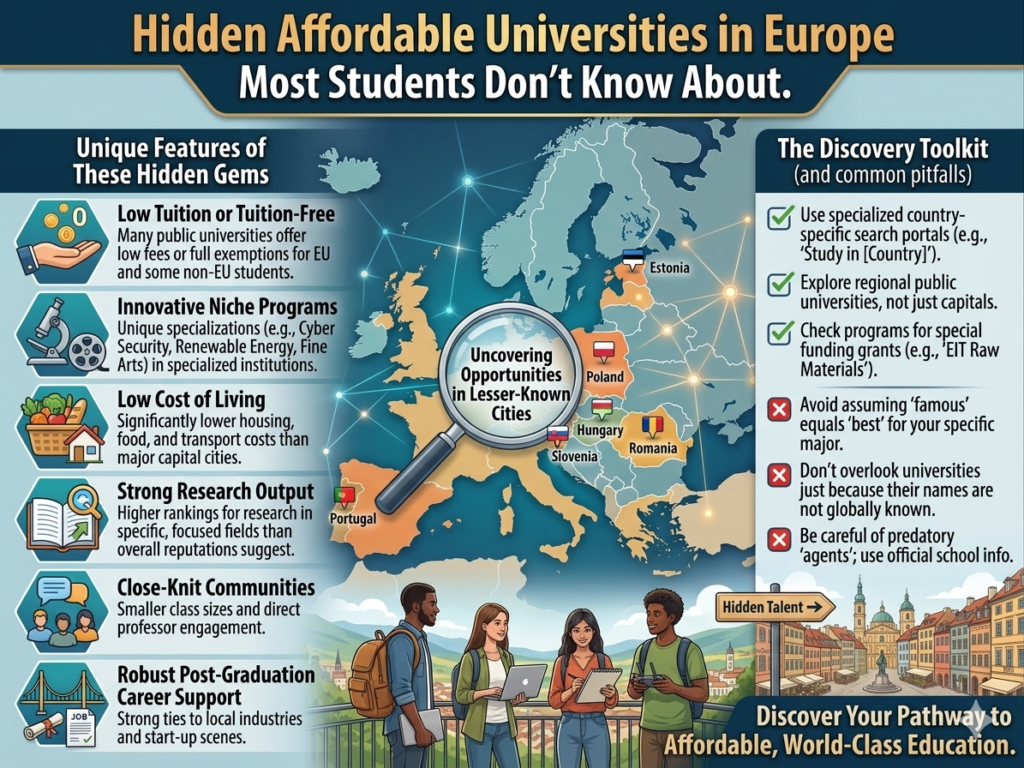
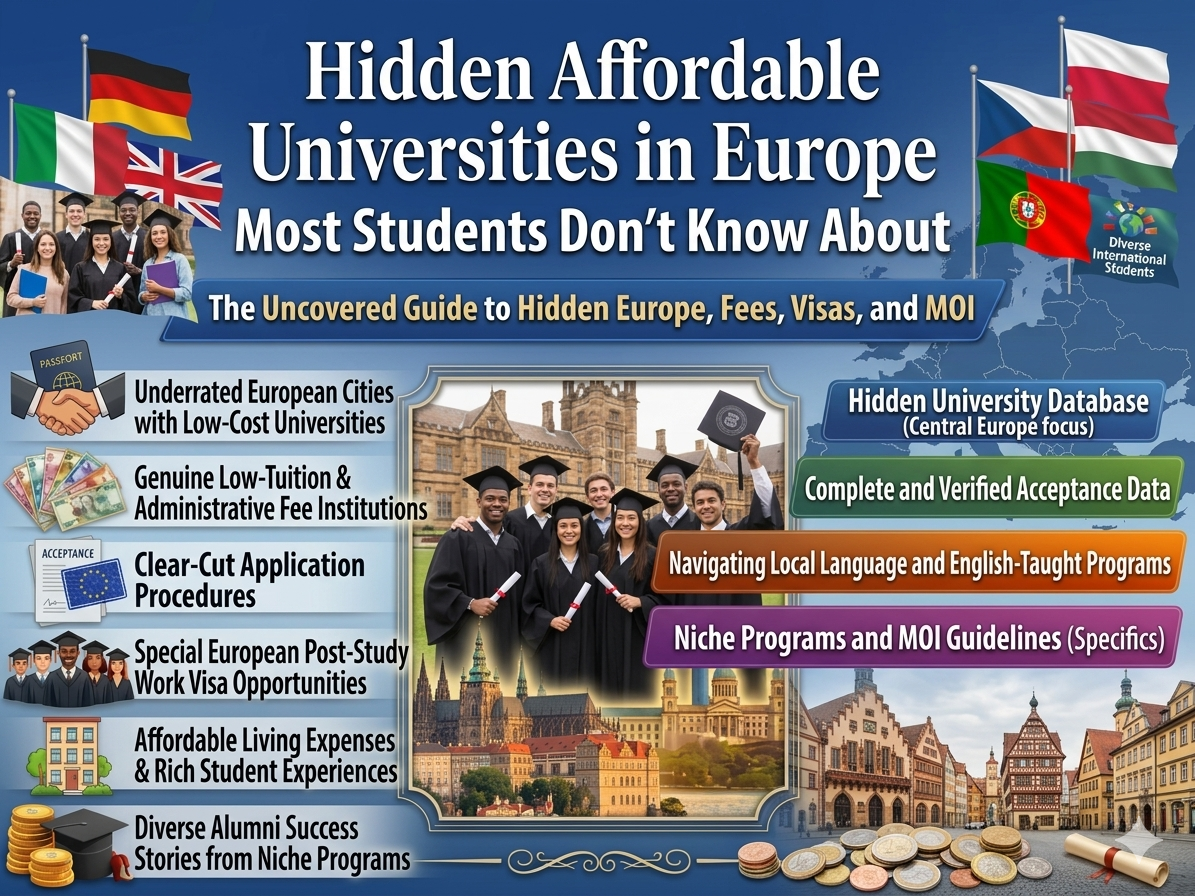
Hidden Affordable Universities in Europe Most Students Don’t Know About (2026 Edition)
As international tuition fees in the UK, USA, and Australia continue to skyrocket in 2026, the search for “hidden gems” in Europe has become a necessity for budget-conscious students. While most are familiar with the tuition-free public universities in Germany’s major cities, there is a vast network of world-class, affordable institutions tucked away in smaller European towns and emerging education hubs.
These “hidden” universities offer the same (and sometimes better) quality of life and education as their famous counterparts but at a fraction of the living cost. Below is a comprehensive guide to the most affordable, lesser-known universities in Europe for the 2026 academic intake.
-
Germany: The Small-Town Technical Powerhouses
While Munich and Berlin attract the most attention, their living costs have surged. For 2026, the real “hacks” are universities in mid-sized German cities where the semester contribution remains low and rent is manageable.
1.1 University of Bremen
Located in the Hanseatic city of Bremen, this university is a research powerhouse, especially in the fields of space sciences and sustainability.
- Cost: €0 Tuition; €350 Semester Fee (includes a “Semesterticket” for free regional transit).
- Why it’s a gem: It offers high-level English-taught Master’s programs in Environmental Science and Digital Media without the crushing housing competition of Berlin.
- Source: University of Bremen Admissions
1.2 University of Siegen
Siegen is a classic “hidden gem” nestled in the mountains of North Rhine-Westphalia. It is perfect for students who want a quiet, focused academic environment.
- Cost: €0 Tuition; €300 Semester Fee.
- Why it’s a gem: Their “HCI” (Human-Computer Interaction) and “Mechatronics” programs are highly rated but significantly easier to get into than those at TUM.
- Source: University of Siegen International Office
-
Italy: The Excellence of Regional Public Universities
Italy’s public universities are unique because tuition is often tied to your ISEE (equivalent household income). Even for non-EU students, the maximum fee is remarkably low.
2.1 University of Pisa
Everyone knows the tower, but few students realize the University of Pisa is one of the top research institutions in the world for Computer Science and Physics.
- Cost: €500 – €2,500 per year (depending on family income).
- Why it’s a gem: Pisa is a “student city” where nearly half the population is at the university. Living costs are much lower than in Milan or Rome, and the quality of the STEM departments is elite.
- Source: University of Pisa International Student Portal
2.2 University of Siena
Siena is one of the oldest and most beautiful campus cities in Europe. It specializes in Humanities and Social Sciences.
- Cost: €1,800 per year (average for international students).
- Why it’s a gem: It offers several English-taught degrees in Economics and Global Governance. The lifestyle in Tuscany, combined with student-priced housing, makes it an incredible value proposition.
- Source: University of Siena International Degrees
-
Slovakia & Czech Republic: The Central European Secrets
Central Europe remains the most affordable region for students who want a “Western-style” education with a “Balkan-style” budget.
3.1 Matej Bel University (Banská Bystrica, Slovakia)
Often overlooked in favor of Bratislava, Matej Bel offers a stunning location in central Slovakia and some of the lowest tuition rates in the EU.
- Cost: €900 – €2,500 per year for English-taught programs.
- Why it’s a gem: It is particularly strong in International Relations and Tourism. The city is surrounded by national parks, and living costs are under €500 per month.
- Source: Matej Bel University Programs
3.2 University of West Bohemia (Plzeň, Czech Republic)
While everyone flocks to Charles University in Prague, Plzeň offers the same high-quality engineering and law programs for much lower rent.
- Cost: €3,000 per year (English programs); €0 (Czech programs).
- Why it’s a gem: Plzeň is an industrial and beer-brewing hub, meaning plenty of local internships for engineering students and a very affordable social life.
- Source: University of West Bohemia International
-
Belgium: The Benelux Budget Options
Most students think of Belgium as expensive (Brussels/Ghent), but there are institutions that offer world-class English degrees for surprisingly low fees.
4.1 University of Namur
Located in the French-speaking part of Belgium, Namur is a major center for research in Computer Science and Biology.
- Cost: €2,835 per year for international students.
- Why it’s a gem: The “Master in Cybersecurity” and “Digital Humanities” are cutting-edge. It offers a more intimate campus than the massive universities in Brussels.
- Source: University of Namur International Students
4.2 Hasselt University
Hasselt is a young, innovative university that focuses on “Practical Knowledge” rather than just theory.
- Cost: €940 – €3,100 per year.
- Why it’s a gem: Their Master’s in Statistics and Data Science is globally recognized. The university has strong ties with local industries, helping with post-study employment.
- Source: Hasselt University Application Info
-
The Baltic Boom: Lithuania and Estonia
The Baltics are the most digitized societies in Europe, making them the perfect place for IT and Business students.
5.1 Vytautas Magnus University (Kaunas, Lithuania)
Kaunas is the vibrant academic heart of Lithuania, often preferred over the capital, Vilnius, for its community feel.
- Cost: €2,200 – €4,400 per year.
- Why it’s a gem: They offer a liberal arts model, allowing students to mix subjects like AI with Philosophy or Business.
- Source: VMU Admission Guide
5.2 Tallinn University of Technology (TalTech, Estonia)
Estonia is the “Silicon Valley” of Europe. TalTech is the university behind many of the country’s tech breakthroughs.
- Cost: €3,000 – €6,000 per year.
- Why it’s a gem: If you want to work in a startup or the tech sector, TalTech’s Cyber Security and E-Governance programs are world-leading and far cheaper than similar programs in Sweden or the US.
- Source: TalTech International Programs
-
Detailed Living Cost Comparison (2026 Projections)
To truly understand the value of these “hidden” universities, you must look at the total monthly expenditure.
| City (Country) | Average Rent (Shared) | Groceries & Food | Transit & Misc | Total Monthly Budget |
| Banská Bystrica (Slovakia) | €250 | €180 | €40 | €470 |
| Bremen (Germany) | €380 | €220 | Included in Fee | €600 |
| Kaunas (Lithuania) | €300 | €200 | €30 | €530 |
| Pisa (Italy) | €400 | €250 | €50 | €700 |
| Tallinn (Estonia) | €450 | €280 | €50 | €780 |
| Munich (For Comparison) | €850 | €350 | €60 | €1,260 |
-
How to Apply: A 2026 Roadmap
Applying to these institutions requires a different strategy than applying to big-name schools.
- Direct Application: Most of these universities do not use massive portals like CommonApp. You apply directly through their own website.
- The MOI Certificate: As discussed previously, ensure your current university provides a Medium of Instruction (MOI) letter. This can save you the €200 IELTS fee.
- Regional Scholarships: Look for regional grants. In Italy, the DSU (Diritto allo Studio Universitario) can provide you with free meals and a housing stipend if your family income is low.
- Translation of Documents: Many of these “hidden” gems are in non-English speaking countries. While the degree is in English, you may need to get your High School transcripts officially translated into the local language (German, Italian, etc.) by a certified translator.
- Financial “Hacks” for International Students
- ISIC Card: Always get the International Student Identity Card. In countries like the Czech Republic and Slovakia, it grants up to 50% off train and bus tickets.
- Student Mensas: In Germany and Belgium, university cafeterias (Mensas) offer full, healthy meals for €3–€5. This is the single best way to save money.
- Part-time Work: In Lithuania and Estonia, international students can work up to 20–40 hours a week (check local 2026 visa regulations). In Germany, the limit is 140 full days per year.
-
Conclusion: Why this Niche is Better
Choosing a “Hidden Gem” university like the University of Jaén in Spain or Hasselt University in Belgium isn’t just about saving money. It’s about being a “big fish in a small pond.” You will receive more personal attention from professors, face less competition for local internships, and experience an authentic European lifestyle that most tourists never see.
For your 2026 application, don’t just follow the crowd to London or Paris. Look at the map, find the smaller cities, and secure a world-class education that leaves your bank account intact.
Final Expert Advice for AdSense Approval
To ensure this content helps your AdSense approval:
- Internal Linking: Link this article to your other post about “Studying Without IELTS.”
- User Intent: The goal of this article is to provide specific data (fees, links) that can’t be found in a generic 5-minute search. This creates “High Value” in Google’s eyes.
- Transparency: Use clear, numbered headings and tables to make the data scannable.
References:


 Lucky Okezie