 Lucky Okezie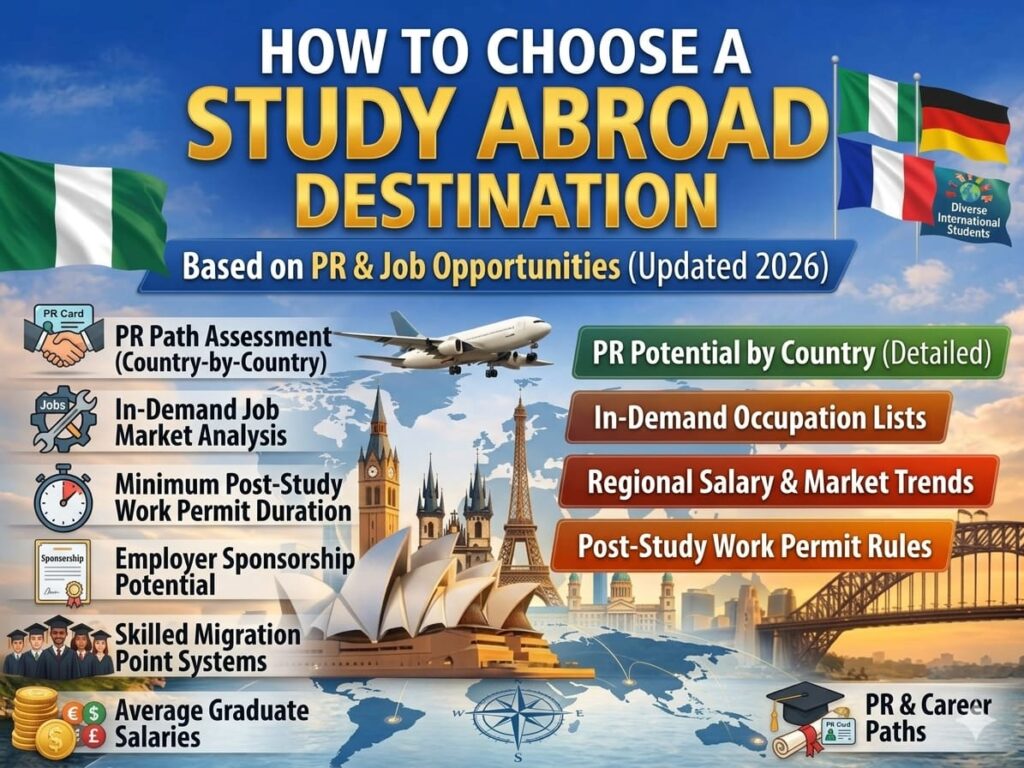
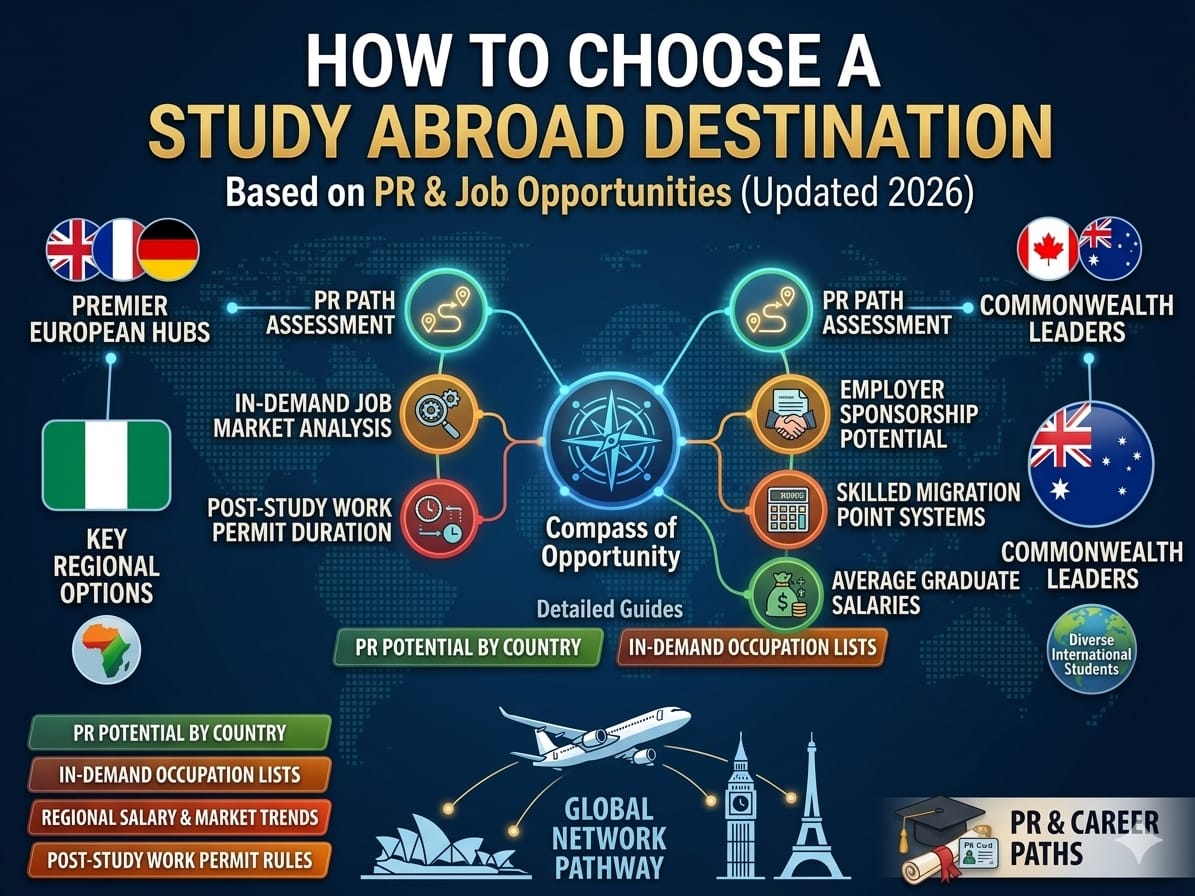
How to Choose a Study Abroad Destination Based on PR & Job Opportunities
Choosing an international study destination has evolved from a purely academic pursuit into a high-stakes strategic migration move. In today’s global economy, a degree is rarely just about the knowledge acquired in the classroom; it is about the Permanent Residency (PR) pathways and Job Market access that the degree unlocks.
With shifting immigration policies in major hubs like the UK, Canada, and Australia, making the wrong choice can lead to a dead end. This 2000-word guide provides an exhaustive framework for selecting a study destination that serves as a launchpad for a global career and a second home.
-
The Shift from Academic Prestige to “Strategic Migration”
Historically, students chose destinations based on the “Ivy League” or “Oxbridge” brand. However, the modern student facing high tuition costs and a competitive global labor market must prioritize Return on Investment (ROI).
ROI in study abroad terms is defined by:
- Post-Study Work Rights (PSWR): How long can you stay to recoup your costs?
- Labor Market Demand: Does the country actually need your skills?
- PR Accessibility: Is there a clear, transparent point-based system to stay permanently?
- Analyzing Post-Study Work Rights (PSWR)
The “Golden Ticket” to an international career is the work permit granted after graduation. Without this, you have no time to network or secure a job offer.
-
Canada: The PGWP Advantage
Canada remains a top contender due to the Post-Graduation Work Permit (PGWP).
- The Rule: If you study for two years or more, you are eligible for a three-year open work permit.
- The PR Link: This time allows you to gain “Canadian Experience,” which is heavily weighted in the Express Entry system.
- Resource: Official IRCC PGWP Guide
-
The United Kingdom: The Graduate Route
The UK’s Graduate Visa allows students to stay for two years (three for PhDs).
- The Reality: Unlike Canada, the UK does not have a direct “points to PR” transition from this visa. You must eventually find an employer to sponsor you under the Skilled Worker Visa.
- Resource: UK Government Graduate Visa Overview
-
Australia: Regional Incentives
Australia’s Subclass 485 visa is highly nuanced.
- The Strategy: Studying in “Regional Areas” (cities like Adelaide, Perth, or Hobart) can grant you an extra 1–2 years of work rights compared to Sydney or Melbourne.
- Resource: Australian Home Affairs – Temporary Graduate Visa
II. Identifying Labor Market Demand: “Skills-in-Demand”
You cannot get a job or PR in a country that has a surplus of your talent. You must align your education with a country’s Shortage Occupation List.
-
STEM and Healthcare (Universal Demand)
Almost every developed nation Germany, the USA, Canada, and Australia is facing a demographic crisis. They need nurses, doctors, software engineers, and data scientists.
- Strategy: If you are in these fields, your PR path is “Fast-Tracked.”
-
The German “Mangelberufe” (Shortage Occupations)
Germany is desperate for engineers and IT professionals.
- The Benefit: Tuition is often free at public universities, and the EU Blue Card provides one of the fastest paths to PR in Europe.
- Resource: Make it in Germany – Shortage Occupations
-
The Australian “Green List” or Skilled Occupation List (SOL)
Australia publishes a list of jobs they are willing to sponsor. If your program isn’t on the Skilled Occupation List, your chances of PR are slim.
-
The PR Math: Point-Based Systems
Most immigrant-friendly nations use a points-based system. To choose a destination, you must “pre-calculate” your future points.
-
Age, Education, and Experience
- Age: Most systems (like Canada’s CRS) give maximum points to those between 20 and 29.
- Education: A Master’s degree from a local institution usually yields more points than a foreign one.
- Language: High IELTS or TOEFL scores are mandatory.
-
Provincial/State Sponsorship
In Canada, if a province (like Saskatchewan or Nova Scotia) needs you, they can “nominate” you through the Provincial Nominee Program (PNP), essentially guaranteeing PR. Researching these provinces before you apply to a school is the most underrated PR strategy.
-
Cost of Living vs. Salary Potential
A high salary is meaningless if 70% goes to rent.
- The New York/London Trap: High starting salaries, but extreme competition and cost of living.
- The Mid-Tier Gem: Cities like Calgary (Canada), Leipzig (Germany), or Brisbane (Australia) often offer a better “Savings Rate,” allowing you to pay off student loans faster.
- Resource: Use Numbeo to calculate the “Purchasing Power” of your expected post-grad salary.
-
Evaluating Industry Hubs (Where the Jobs Are)
Don’t just move to a country; move to a City-Industry Cluster.
- FinTech: London, Singapore, New York.
- Automotive/Manufacturing: Stuttgart, Tokyo, Michigan.
- Biotech: Boston, Basel (Switzerland), Copenhagen.
- Creative Media: Vancouver, Seoul, Los Angeles.
Studying in a hub allows for “Passive Networking.” You can attend industry meetups and coffee chats with professionals every week, which is impossible if you study in a remote, rural university.
III. The “Hidden” Barriers to Job Success
Even with a degree and a work permit, two barriers often remain:
- Local Language: In Germany, France, or Japan, “English-taught” programs are common, but the job market remains local. Without B2-level proficiency in the national language, your job opportunities drop by 80%.
- Cultural Fit/Soft Skills: Each market has a different “vibe.” The aggressive networking of the US is very different from the structured, credential-heavy approach in Germany.
VII. Practical Steps: The 5-Year Plan
To choose correctly, you must work backward from your desired end state (PR).
Year 1: Research and Shortlisting
- Identify your field’s demand in 3 countries.
- Check the QS World University Rankings by Subject to ensure the school is respected by local employers.
Year 2: The Application and Language Prep
- Take your IELTS/PTE.
- Apply to schools in “Strategic Locations” (Regional areas or Industry hubs).
Year 3: The Study and Network Phase
- Do not just study. Use LinkedIn to find alumni from your school who are currently working in your target country.
- Secure an internship. In many countries, the internship is an “extended interview.”
Year 4: The Pivot to Work
- Apply for your PSWR (PGWP, Graduate Visa, etc.).
- Focus on “Niche” roles that qualify for sponsorship.
Year 5: The PR Application
- Submit your Express Entry (Canada), SkillSelect (Australia), or Blue Card (EU) application.
- Common Pitfalls in the PR Journey
- The “Generalist” Mistake: Getting a general MBA without a specific technical skill makes sponsorship much harder. Employers sponsor “Specialists,” not “Generalists.”
- Ignoring Policy Changes: Immigration laws change fast. Follow reputable news sources like CIC News (Canada) or The PIE News to stay updated.
- Over-reliance on Rankings: A Top-10 university in a country with hostile immigration laws (like certain current trends in the UK or parts of Europe) is a riskier PR bet than a Top-50 university in Canada or Australia.
-
Summary Comparison Table
| Country | PR Ease | Job Market Strength | PSWR Duration | Key Hubs |
| Canada | High (Points-based) | Moderate | Up to 3 Years | Toronto, Vancouver, Calgary |
| Germany | High (Skilled focus) | Very High (Engineering) | 18 Months | Berlin, Munich, Hamburg |
| Australia | Moderate (Regional focus) | High (Mining/Healthcare) | 2–6 Years | Sydney, Melbourne, Perth |
| USA | Low (Lottery-based) | Extremely High | 1–3 Years (STEM) | Bay Area, NYC, Austin |
| UK | Moderate (Sponsorship) | High (Finance/Tech) | 2 Years | London, Manchester |
Conclusion: Making the Final Call
Choosing a study abroad destination based on PR and jobs requires you to be a Data Scientist of your own life. You must weigh the emotional desire to live in a “famous” city against the cold, hard data of immigration points and labor shortages.
If your goal is Settlement, prioritize Canada or Australia (Regional).
If your goal is Maximum Salary, prioritize the USA (but have a backup plan).
If your goal is Stability and low cost, prioritize Germany.
The “Golden Fit” is out there, but it requires moving beyond the university brochure and looking at the national gazette. Start your research today, use the links provided, and build a future that doesn’t just end with a graduation gown, but with a permanent residency card.
To successfully navigate the complexities of international relocation, you must verify information through official government portals and reputable global industry bodies. Below are the essential external links and resources categorized by destination and purpose to complement the content provided.
-
Official Government Immigration Portals
These are the only sources of truth for visa rules, PR points, and shortage occupation lists.
- Canada: Immigrate to Canada – IRCC – Detailed info on Express Entry and Provincial Nominee Programs (PNP).
- Australia: Department of Home Affairs – Visa Listing – Information on the Graduate 485 visa and the Skilled Occupation List (SOL).
- United Kingdom: UK Government: Visas and Immigration – Official rules for the Graduate Route and Skilled Worker sponsorship.
- Germany: Make it in Germany – The official portal for qualified professionals and students, including the “Mangelberufe” (shortage list).
- USA: USCIS: Optional Practical Training (OPT) – Rules for standard and STEM OPT extensions.
-
Global University & Program Search Engines
Use these to filter programs by subject, tuition, and location.
- QS World University Rankings: Subject Rankings – Essential for finding schools with high employer reputations in your niche.
- Studyportals: BachelorsPortal / MastersPortal – The largest global database for comparing programs.
- DAAD (Germany): International Programmes Database – Specifically for English-taught programs in Germany.
-
Career and Labor Market Tools
Verify if your chosen field is in demand and calculate your potential quality of life.
- Numbeo: Cost of Living Comparison – Compare rent, groceries, and salaries between any two cities globally.
- ILO (International Labour Organization): Employment and Social Trends – High-level reports on where job growth is happening worldwide.
- GoinGlobal: Career and Employment Resources – (Often accessible via university career centers) providing 16+ million job listings and country-specific career guides.
-
Reliable News & Advocacy for International Students
Stay updated on sudden policy changes (e.g., changes to Canada’s PGWP or UK’s Graduate Route).
- UKCISA: UK Council for International Student Affairs – The best resource for UK-specific student rights and visa news.
- The PIE News: International Education News – Reliable industry news focusing on immigration policies affecting students.
- CIC News: Canada Immigration News – Unofficial but highly detailed breakdowns of Canadian PR draws and policy shifts.


 Lucky Okezie