 Lucky Okezie
The Global Student Blueprint: How to Choose Countries, Schools, and Programs That Fit Your Goals
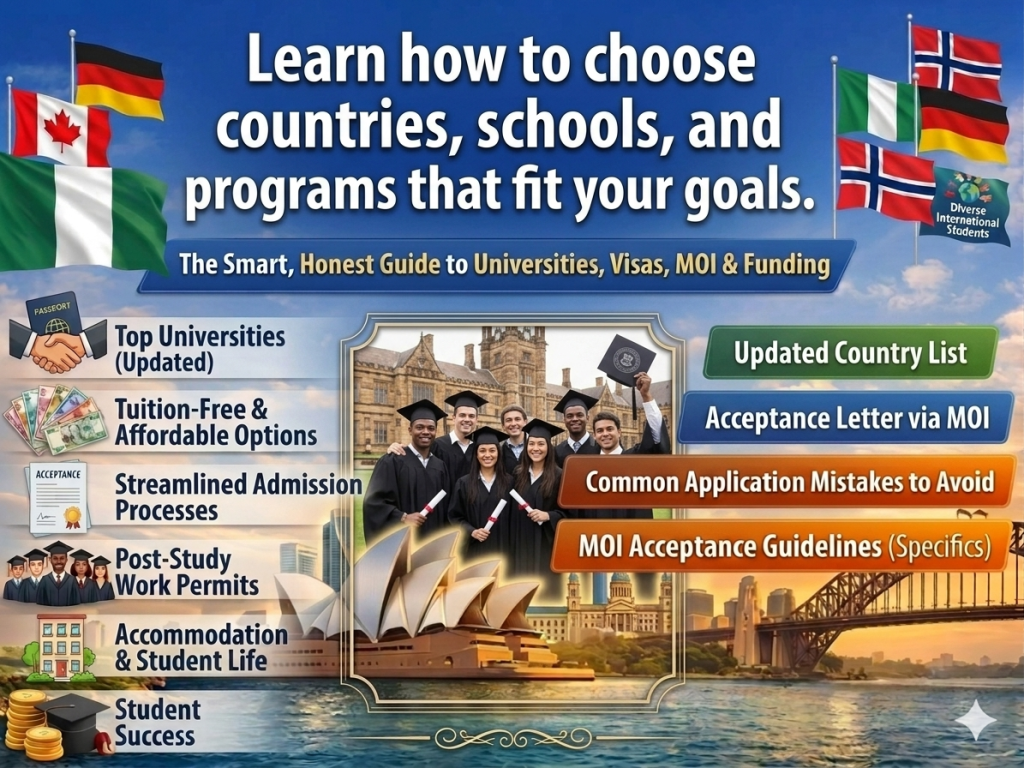
How to Choose Countries, Schools, and Programs That Fit Your Goals
Choosing where to study and live is a decision that ripples through your entire professional and personal life. It is more than just a search for an academic credential; it is a strategic investment in your future. Navigating the thousands of global options requires a systematic approach to filter through the noise and identify the “Golden Fit”, the intersection of your career ambitions, financial realities, and personal lifestyle.
This guide provides a comprehensive framework for selecting the right country, institution, and program to ensure your international education journey is both successful and transformative.
I. Defining Your North Star: Self-Assessment
Before opening a single university website, you must look inward. Without a clear set of personal goals, you risk being swayed by marketing or prestige rather than utility.
Clarify Your Long-Term Objectives
Ask yourself: “What is the ultimate goal of this degree?” The answer to this question should dictate every subsequent decision.
- Career Advancement: Are you looking for a specific skill set to climb the ladder in your current field? If so, you need a program with strong industry ties and a curriculum focused on the latest technological or managerial trends.
- Career Pivot: Are you changing industries entirely? Look for “Conversion Masters” or programs that accept students from diverse academic backgrounds and offer intensive foundational modules.
- Migration and Settlement: Is your primary goal to gain work experience and permanent residency? If so, the country’s immigration policy is more important than the school’s global ranking.
- Academic Pursuit: Are you aiming for a PhD or a career in research and development? Your focus should be on faculty citations, laboratory funding, and research output.
Identify Your Learning Style
Educational systems vary wildly by country.
- The Continental Model (e.g., Germany, France): Often highly independent. You are expected to manage your own time with fewer “check-ins” from professors.
- The Anglo-Saxon Model (e.g., USA, UK): Typically involves more continuous assessment, quizzes, and group projects.
- Applied vs. Theoretical: Do you thrive in small, discussion-based seminars or large, lecture-heavy environments? Do you prefer a hands-on, vocational approach (Found in Universities of Applied Sciences) or a theoretical curriculum?
Financial Boundary Setting
Be honest about your budget. This includes tuition, but also the “hidden” costs: visa fees, mandatory health insurance, airfare, and the monthly cost of living.
- Strategic Tool: Use Numbeo’s Cost of Living Comparator to see how your current expenses translate to cities like London, Sydney, or Berlin.
- Budgeting Tip: Always add a 20% “buffer” to your estimated costs to account for currency fluctuations and emergency expenses.
II. Level 1: Choosing the Right Country
The country you choose determines your quality of life, your legal rights, and your post-graduation job prospects.
Post-Study Work Rights (PSWR)
For many, the ability to work after graduation is the only way to see a Return on Investment (ROI).
- The UK: Currently offers a Graduate Route visa allowing 2-3 years of work without needing a sponsor initially.
- Canada: Famed for the Post-Graduation Work Permit (PGWP), which is a direct bridge to Permanent Residency.
- Australia: Offers Temporary Graduate visas (Subclass 485) that vary in length based on your level of study and location.
- Germany: Provides an 18-month job-seeker visa specifically for international graduates to find a role related to their degree.
Economic and Industry Alignment
Don’t study where you can’t work. Choose a country that is a “hub” for your specific industry.
- Tech and Software: The USA remains the leader (Silicon Valley), but Germany (Berlin) and Ireland (Dublin) are massive European hubs.
- Finance: The “Golden Triangle” of London, New York, and Singapore remains dominant.
- Automotive and Mechanical Engineering: Germany and Japan offer the most robust industrial ecosystems.
- Sustainability and Green Energy: Look toward Scandinavia or the Netherlands, where government policy drives massive private sector investment in “Green Tech.”
Cultural and Lifestyle Integration
You will be living there for 1- 4 years. If you hate cold weather, the “perfect” program in Oulu, Finland, might become a burden. Use WeatherSpark to analyze the actual day-to-day climate of your potential new home. Consider language barriers as well, while many programs are taught in English, daily life in rural France or Italy will require local language proficiency.
III. Level 2: Choosing the Right Program
The program is the core of your investment. Even a prestigious university can have a lackluster program in a specific niche.
Curriculum and Specialization: The Deep Dive
Don’t just look at the program title. You must download the Module Handbook or Syllabus.
- Specific Tools: If you are an engineer, does the program teach the specific software (e.g., MATLAB, AutoCAD) used by employers in that country?
- Electives: Does the program offer enough flexibility for you to specialize in a sub-field (e.g., AI within Computer Science)?
- Modernity: Is the curriculum updated? A program still focusing on 2015 marketing trends is a poor investment in 2026.
Accreditation and Global Recognition
An unaccredited degree is often worthless for professional licensing.
- Business: Look for the “Triple Crown”: AACSB, AMBA, and EQUIS.
- Engineering: Check if the program is a signatory of the Washington Accord, ensuring your degree is recognized in dozens of other countries.
- Architecture/Medicine: Contact the professional board in your home country to ensure they will recognize the foreign qualification.
Internship and Practical Components
Does the program include a “Co-op” or mandatory internship semester? In today’s hyper-competitive job market, work experience is often more valuable than the degree itself. Programs with built-in industry placements (like those in Canada or Germany’s FH schools) offer a massive head start.
Level 3: Choosing the Right School
Once you know the “what” (program) and “where” (country), you must choose the “who” (institution).
Rankings vs. Reality
While QS World University Rankings and Times Higher Education are the industry standards, they are heavily weighted toward research citations.
- Subject Rankings: A school ranked 300th globally might be Top 10 for your specific subject. Always filter by department.
- Employer Reputation: Look at the “Global Employability University Ranking” to see which schools HR managers actually prefer.
Campus Culture and Demographics
- International Student Ratio: A school with a high percentage of international students (e.g., LSE in London) will have much more sophisticated support systems for visas, housing, and cultural adjustment.
- Urban vs. Campus University:
- Urban (e.g., NYU, University of Toronto): The city is your campus. Better for networking, but can be lonelier.
- Campus (e.g., Stanford, University of Warwick): A self-contained bubble. Great for social life and focus, but potentially isolated from the “real world” job market.
Support Services and Career Centers
The quality of a school’s Career Services Center can be the difference between getting a job and moving back home. Investigate:
- Do they host industry-specific job fairs?
- Do they provide 1-on-1 resume critiques and mock interviews?
- Do they have an active Alumni network on LinkedIn that you can leverage?
Practical Steps for Narrowing Your Search
The process can be overwhelming. Follow this 4-step workflow:
Step 1: The “Wide Net” (Months 1–2)
Use global search engines to identify 20 programs that look interesting.
- Studyportals (General)
- FindAMasters (Postgrad specific)
- DAAD (Specifically for Germany)
Step 2: The “Reality Check” (Months 2–3)
Apply your hard filters. Eliminate anything that doesn’t fit your budget or language proficiency.
- Language: Register for IELTS or TOEFL early.
- Funding: Check International Scholarships for external funding sources.
Step 3: The “Deep Dive” (Months 3–4)
Reach out to current students or alumni. Use LinkedIn and search for “[University Name] + [Your Program Name]”. Ask them: “Is the program as practical as the website claims?” or “How hard was it to find an apartment in this city?”
Step 4: The “Final Five”
Apply to five schools to balance your risk:
- 2 Dream Schools: Prestigious, high entry requirements.
- 2 Target Schools: Your profile fits their average student perfectly.
- 1 Safety School: You are almost guaranteed admission.
IV. Common Pitfalls to Avoid
- Chasing Prestige Only: A degree from an Ivy League school in a field they aren’t known for is often less valuable than a degree from a specialized technical university (like TU Delft or Georgia Tech).
- Ignoring the “Local” Job Market: Some degrees don’t “travel” well. If you study Law in the UK, practicing in the USA requires significant additional hurdles.
- Relying Solely on Agents: Remember that many education agents are paid commissions by specific universities. Always cross-reference their “recommendations” with independent research.
V. Conclusion
Choosing your path is an exercise in balancing your heart with your head. Your goal defines the program; your career prospects define the country; and your budget and personality define the school.
When these three levels align, you don’t just get a degree, you get a launchpad. Take your time, verify the data, and remember that the “best” school in the world is the one that allows you to become the person you intend to be. Start your spreadsheets, update your LinkedIn, and begin the journey toward your global future.
About the Author
Travel & Tour Editorial Team
The editorial team at TravelAndTour.com.ng is passionate about helping travelers explore the world with confidence. Our editor oversees the creation and publication of high-quality travel guides, visa information, destination insights, scholarship updates, and practical travel tips designed to make every journey smoother and more enjoyable.
With a strong focus on reliable information and real travel experiences, the editor ensures that every article is well-researched, informative, and useful for both first-time travelers and seasoned explorers.
From visa application guides and international travel opportunities to destination highlights and travel planning advice, our goal is to provide readers with the knowledge they need to travel smarter.
At TravelAndTour.com.ng, we believe travel opens doors to new cultures, ideas, and opportunities.
Through carefully curated content, our editorial team strives to inspire readers to discover new destinations and experience the world with confidence.


 Lucky Okezie