 Lucky Okezie
Smart Complete Guide: Admission Requirements for Nigerian Students Studying Abroad (2026)
Learn the admission requirements for Nigerian students studying abroad, including transcripts, IELTS, proof of funds, and visa rules for Canada, UK, USA, and Germany.
Our main Focus is on: Admission Requirements for Nigerian Students Studying Abroad
Introduction
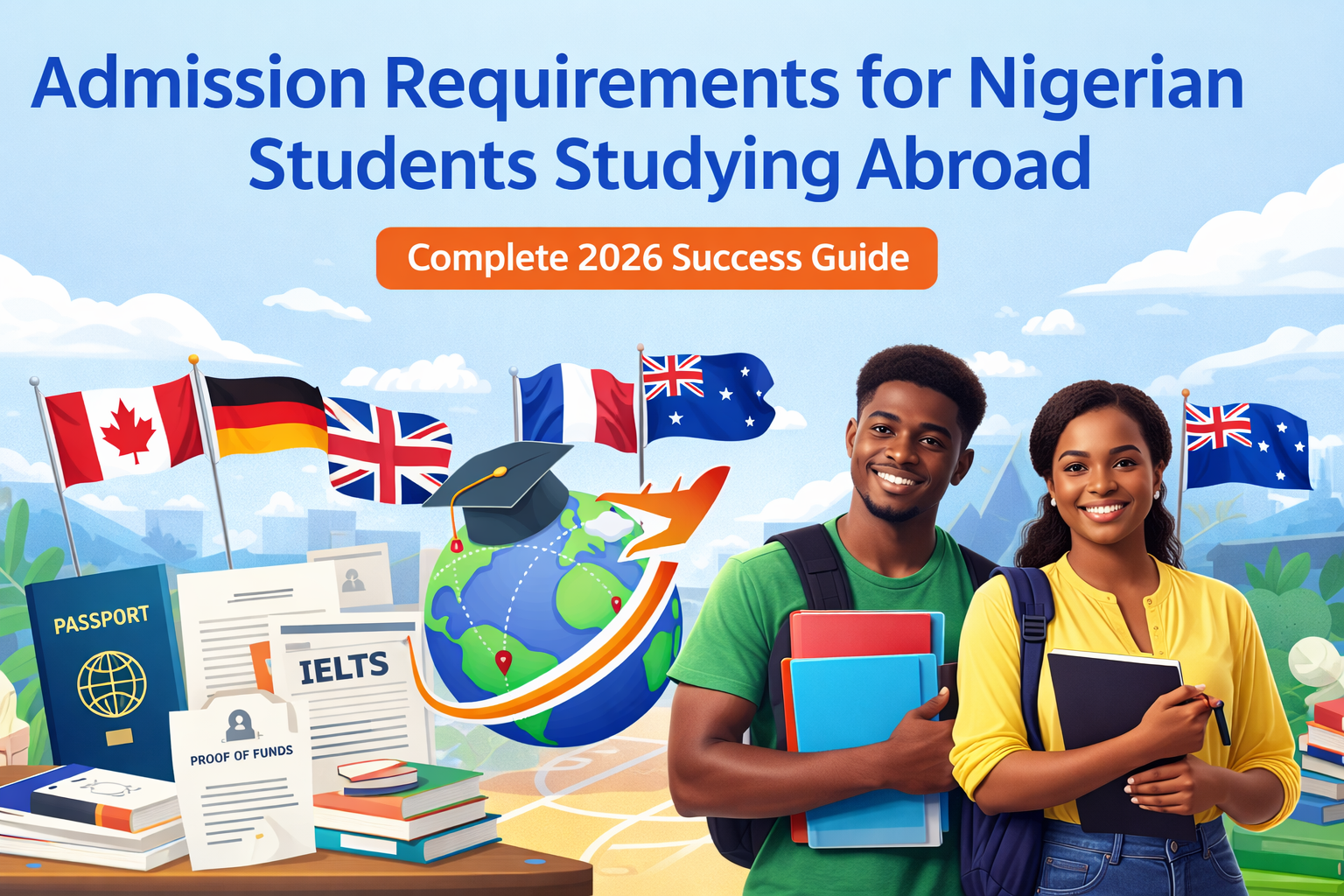
Admission requirements for Nigerian students studying abroad are often more detailed than many applicants expect. Every year thousands of Nigerian students apply to universities across Canada, the United Kingdom, the United States, Germany, Australia, and other countries in search of better education and global career opportunities.
For many families, studying abroad represents more than just a degree. It can provide access to stronger academic resources, global professional networks, and career pathways in fields such as technology, healthcare, engineering, finance, and law.
Yet the admission process is rarely simple.
Some students transition smoothly because they understand the requirements early. Others face delays, rejections, or financial loss because they underestimate how structured the process can be.
Admission success is rarely about luck.
It usually comes from planning ahead, preparing documents correctly, and understanding how both universities and immigration systems evaluate international applicants.
This guide explains the admission requirements for Nigerian students studying abroad in clear, practical language. Whether you plan to apply for a bachelor’s degree, master’s program, diploma, or PhD, the goal is to help you understand:
- what universities expect academically
- what immigration authorities require
- why these requirements exist
- how to prepare your documents correctly
Throughout the guide, you will see practical examples, structured tables, and realistic advice designed to help Nigerian applicants avoid the mistakes that delay or damage many applications.
Important Disclaimer
Admission rules, visa requirements, proof-of-funds thresholds, and document formats can change depending on government policies and university regulations.
Always confirm the latest details directly through official government and university websites before submitting applications or paying fees.
- Canada Study Permit Information
https://www.canada.ca/en/immigration-refugees-citizenship/services/study-canada.html - UK Student Visa Guidance
https://www.gov.uk/student-visa - U.S. Student Visa Information
https://travel.state.gov/content/travel/en/us-visas/study.html
This article provides educational guidance and should not replace official immigration advice.
The Big Picture Nigerians Must Understand
Many Nigerian students focus only on university admission requirements. However, studying abroad actually involves two different decision-makers.
Gatekeeper 1: The University
The university determines whether you qualify academically for a specific program.
They evaluate:
- academic transcripts
- test scores
- statement of purpose
- recommendation letters
- research experience
If satisfied, the university issues an admission offer.
Gatekeeper 2: Immigration Authorities
Even if a university admits you, immigration officers still decide whether you are allowed to enter the country as a student.
Immigration authorities review:
- financial proof
- study plan
- document consistency
- intent to follow visa rules
This means a student can receive admission but still be refused a visa if financial or documentation issues appear unclear.
For Nigerian applicants, this is why the admission strategy and visa strategy must work together from the start.
Step-by-Step Roadmap for Nigerian Students
The admission process becomes much easier when students follow a structured plan.
Successful applicants usually treat studying abroad like a long-term project with stages rather than rushing the process.
Step 1: Choose a Country and Program Carefully
Before gathering documents, students should decide:
- study level (undergraduate, master’s, PhD)
- academic field
- financial capacity
- career goals
Different countries have different admission expectations.
| Country | Typical Admission Requirements |
|---|---|
| Canada | Transcripts, IELTS, Statement of Purpose |
| United Kingdom | Transcripts, references, personal statement |
| United States | SAT/GRE, essays, recommendation letters |
| Germany | Transcripts, blocked account proof |
For example, a student with strong grades but limited funding may consider Germany because public universities often have lower tuition.
If you are comparing study destinations, you can also review resources such as:
Cost of Studying in Canada from Nigeria
Step 2: Create a Requirements Folder
A simple habit improves admission success dramatically.
Create a structured folder containing all required documents.
Use both digital and physical copies.
Identity Documents
- international passport
- birth certificate
- name affidavit (if necessary)
Small inconsistencies in names across documents can delay verification.
Academic Documents
- WAEC or NECO certificate
- university transcripts
- degree certificate
- NYSC certificate (sometimes required)
Transcript processing can take time in Nigerian universities, so request them early.
Core Admission Requirements Most Universities Share
Although admission systems vary internationally, most universities evaluate similar documents.
Academic Grades and Transcripts
Your transcript shows universities your academic preparation.
Admissions teams review:
- subjects studied
- grade trends
- overall academic strength
For example, the University of Toronto explains transcript expectations here:
https://future.utoronto.ca/apply/requirements/
English Language Proficiency Tests
International universities require proof that students can study in English.
- IELTS Academic
- TOEFL
- PTE Academic
- Duolingo English Test
| Test | Typical Minimum Score |
|---|---|
| IELTS | 6.0 – 7.0 |
| TOEFL | 80 – 100 |
| PTE | 55 – 65 |
| Duolingo | 100 – 120 |
Some universities waive English tests if previous education was conducted in English.
Statement of Purpose (SOP)
The statement of purpose explains:
- why you chose the program
- why you chose that country
- your long-term career goals
A strong SOP tells a clear academic story.
Example:
A Nigerian student studying microbiology may pursue a master’s degree in public health to improve disease prevention programs in Africa.
Letters of Recommendation
Recommendation letters confirm your academic or professional potential.
These letters often come from:
- professors
- lecturers
- work supervisors
Oxford University provides recommendation guidance here:
https://www.ox.ac.uk/admissions/graduate/applying-to-oxford/application-guide
Curriculum Vitae (CV)
Many postgraduate programs request a CV showing:
- education history
- work experience
- research projects
- internships
- publications
Portfolio Requirements
Creative programs such as architecture, design, film, and art often require portfolios.
Admission Requirements by Study Level
| Requirement | Undergraduate | Master’s | PhD |
|---|---|---|---|
| WAEC / NECO | Yes | Sometimes | Rare |
| Transcripts | Yes | Yes | Yes |
| Statement of Purpose | Often | Yes | Yes |
| Recommendation Letters | Sometimes | Common | Required |
| English Test | Often | Often | Often |
| Research Proposal | No | Sometimes | Yes |
Understanding Tuition and Living Costs
Students must plan for more than tuition.
Typical expenses include:
- accommodation
- food
- transport
- insurance
- books
Detailed breakdown here:
Cost of Studying in Canada from Nigeria
Proof of Funds for Student Visa
| Country | Typical Financial Requirement |
|---|---|
| Canada | Tuition + living expenses |
| United Kingdom | £1,334 per month |
| Australia | AUD 24,505 |
| Germany | €11,208 blocked account |
Country-Specific Admission and Visa Systems
United States
https://studyinthestates.dhs.gov
United Kingdom
https://www.gov.uk/student-visa
Canada
https://www.canada.ca/en/immigration-refugees-citizenship/services/study-canada.html
Germany
https://www.study-in-germany.de
Seven Common Reasons Nigerian Students Get Rejected
- inconsistent documents
- weak statement of purpose
- unclear funding source
- poor program choice
- late application submission
- fake documents
- overreliance on part-time work expectations
Realistic Timeline for Studying Abroad
| Timeline | Task |
|---|---|
| January – March | Research programs |
| April – June | Take IELTS or TOEFL |
| July – September | Submit university applications |
| October – December | Receive admission decisions |
| January – April | Prepare visa application |
| May – August | Plan travel |
FAQ
What are the admission requirements for Nigerian students studying abroad?
Most universities require transcripts, English test scores, statement of purpose, and recommendation letters.
Can Nigerian students study abroad without IELTS?
Some universities waive IELTS if previous education was conducted in English.
Do I need an agent?
No. Many Nigerian students successfully apply directly through official university portals.
Final Notes Before Paying Any Application Fee
Studying abroad is achievable for many Nigerian students.
The key is preparation.
- organize documents early
- keep your academic story consistent
- apply early
When your documents, program choice, and funding strategy align, the process becomes significantly easier.
About the Author
Travel & Tour
Editor – TravelAndTour.com.ng
The editorial team at TravelAndTour.com.ng is passionate about helping travelers explore the world with confidence. Our editor oversees the creation and publication of high-quality travel guides, visa information, destination insights, scholarship updates, and practical travel tips designed to make every journey smoother and more enjoyable.
With a strong focus on reliable information and real travel experiences, the editor ensures that every article is well-researched, informative, and useful for both first-time travelers and seasoned explorers.
From visa application guides and international travel opportunities to destination highlights and travel planning advice, our goal is to provide readers with the knowledge they need to travel smarter.
At TravelAndTour.com.ng, we believe travel opens doors to new cultures, ideas, and opportunities.
Through carefully curated content, our editorial team strives to inspire readers to discover new destinations and experience the world with confidence.


 Chiprince


 Lucky Okezie