 Lucky Okezie
Introduction: Why this guide exists (and who it’s really for)
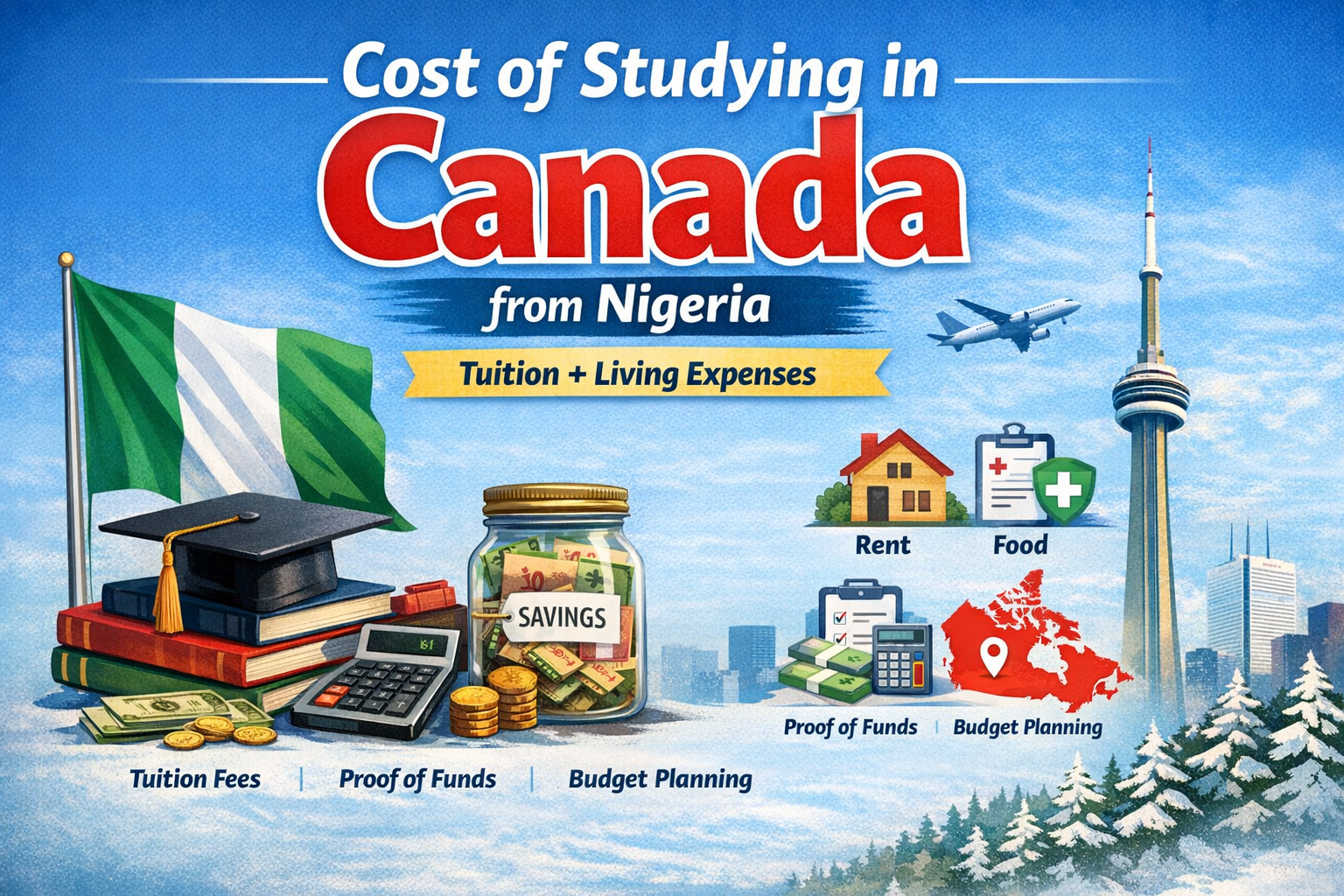
If you’re a Nigerian hoping to study in Canada, you’ve probably encountered wildly different figures online and offline.
One consultant says Canada is “affordable.”
Another post claims you need “nothing less than $100,000.”
A friend already abroad complains daily about rent and bills.
It’s confusing and you’re not wrong to feel that way.
This guide was created to address one specific issue: helping Nigerians understand the real cost of studying in Canada before committing money, time, or documents.
It is especially useful for:
- Students in Nigeria (Lagos, Benin City, Abuja, Enugu, Ibadan, Port Harcourt, and other cities)
- Applicants considering Bachelor’s, Master’s, PhD, or college diploma programs
- Parents and sponsors who want facts, not sales talk
Rather than selling hope, this article explains why costs are structured the way they are, how to plan realistically from Nigeria, and what steps to take using official data and real-life budgeting logic.
If you are still researching the general process of studying in Canada from Nigeria, this guide fits directly into that journey.
By the end, you should be able to answer with confidence:
“Can I truly afford to study in Canada, and what should I do next?”
What you’ll learn
- Current tuition ranges across study levels in Canada
- What Nigerian students typically spend on living expenses
- Canada’s official proof-of-funds expectations
- How to budget accurately from Nigeria
- Why city choice affects your total cost
- Common financial mistakes Nigerians make and how to avoid them
- A downloadable checklist covering documents and costs
- A simple calculator table to estimate your budget
Important Disclaimer (Please Read)
This article relies on information from Canadian government sources and official school websites. However, figures and requirements can change due to immigration policy updates, inflation, or institutional decisions.
Always confirm details directly from official platforms such as:
Immigration, Refugees and Citizenship Canada (IRCC)
This content is for educational purposes only and should not be considered legal or financial advice.
Step-by-Step: How Nigerians Should Budget for Studying in Canada
Step 1: Choose your study level carefully
Your chosen level of study directly affects tuition, visa expectations, and total financial commitment.
- Undergraduate (Bachelor’s): Usually 4 years and the most expensive overall.
- Master’s degree: Typically 1–2 years and very popular with Nigerian applicants.
- PhD: Often funded or partially funded but highly competitive.
- College / Diploma programs: Shorter, skill-focused, and generally more affordable.
Why this matters:
A four-year Bachelor’s degree and a one-year postgraduate diploma have completely different financial realities.
Before budgeting, also review admission requirements for Nigerian students studying abroad, as entry criteria influence timelines and costs.
Official program search portal:
EduCanada – Government of Canada
Step 2: Understand tuition costs (realistic ranges)
Canada does not operate a fixed tuition system. International student fees vary by institution, province, and program type.
| Study Level | Typical Annual Tuition (CAD) |
|---|---|
| Undergraduate | 30,000 – 50,000 |
| Master’s | 18,000 – 35,000 |
| MBA / Professional Programs | 35,000 – 60,000+ |
| PhD | 5,000 – 20,000 (often offset by funding) |
| College / Diploma | 10,000 – 20,000 |
Reality check:
Top-ranked universities offer strong reputations, but they come at a higher cost. Choosing a lesser-known DLI-approved institution does not automatically reduce your visa chances.
Official tuition examples:
Step 3: Living expenses (where many budgets collapse)
Living costs often cause more financial stress than tuition, especially in the first year. These expenses depend largely on location and lifestyle.
| Expense | Estimated Cost (CAD / year) |
|---|---|
| Rent & Accommodation | 8,000 – 15,000 |
| Food & Groceries | 3,000 – 5,000 |
| Transportation | 1,000 – 1,500 |
| Utilities & Phone | 1,200 – 2,000 |
| Health Insurance | 600 – 1,000 |
| Books & Supplies | 500 – 1,500 |
| Total (Living Only) | 15,000 – 22,000+ |
Many Nigerian students underestimate rent, winter clothing, and utility costs in their first year.
Cost Breakdown by Major Provinces & Cities
| City / Province | Annual Living Cost (CAD) | What to Know |
|---|---|---|
| Toronto, Ontario | 22,000 – 28,000 | High rent, strong job market |
| Vancouver, BC | 22,000 – 27,000 | Expensive housing, mild climate |
| Montreal, Quebec | 15,000 – 20,000 | Lower cost, French is helpful |
| Calgary, Alberta | 16,000 – 22,000 | Lower taxes, energy-focused economy |
| Halifax, Nova Scotia | 14,000 – 18,000 | Smaller city, lower rent |
Canada Study Permit: Proof of Funds Nigerians Must Show
Before approving a study permit, IRCC must be satisfied that you can cover tuition, living expenses, and transportation.
Official guidance:
Proof of Financial Support – IRCC
| Situation | Required Living Funds (CAD) |
|---|---|
| Student only | 22,895 |
| Student + Spouse | 28,502 |
| Student + One Child | 32,004 |
Important: These figures exclude tuition fees.
Canada Study Cost Calculator (Planning Estimates)
| Study Level | Tuition | Living Cost | Travel & Insurance | Estimated Total (CAD) |
|---|---|---|---|---|
| Undergraduate | 40,000 | 20,000 | 2,000 | 62,000 |
| Master’s | 28,000 | 18,000 | 2,000 | 48,000 |
| PhD (Part-funded) | 10,000 | 18,000 | 2,000 | 30,000 |
| Diploma | 15,000 | 16,000 | 2,000 | 33,000 |
Common Mistakes Nigerians Make (and How to Avoid Them)
- Depending on part-time work as proof of funds
- Selecting cities without researching rent costs
- Believing promises of “guaranteed visas”
- Failing to confirm DLI status
Verify DLI status here:
Designated Learning Institutions List
FAQ
Can I work while studying?
Yes. International students may work up to 20 hours per week during academic sessions.
Is a PhD cheaper?
Often yes, due to funding, but admission is highly competitive.
Are diploma programs worth it?
Yes, especially for practical skills and PGWP eligibility.
Is health insurance compulsory?
Yes. Coverage varies by province.
Final Advice on Cost of Studying in Canada from Nigeria
Studying in Canada can be life-changing but only with proper planning.
If the numbers don’t align yet, take time to save, explore cheaper provinces, or choose shorter programs. Avoid rushed decisions that can create long-term financial pressure.
Downloadable Checklist (PDF)
Download the Canada Study Plan Checklist for Nigerians (PDF)
Author Bio
About the Author:
This guide was researched and written by an international education researcher with extensive experience analyzing Canadian immigration policies, tuition frameworks, and student financial requirements with a strong focus on Nigerian and African applicants. The aim is clarity, honesty, and practical guidance students can rely on.


 Chiprince


 Lucky Okezie